
Summary: Beta-sitosterol is a plant compound that looks a lot like cholesterol. The best-supported beta-sitosterol benefits are modest: easier urination in men with an enlarged prostate (from a handful of short trials in the 1990s) and lower LDL cholesterol, but only at gram-level doses usually taken in fortified foods. Claims about hair loss and testosterone rest on very little human evidence.
Beta-sitosterol turns up in prostate formulas, hair-loss supplements and “testosterone boosters.” So what does beta-sitosterol actually do, and how strong is the evidence? Here’s what the research says, in plain English.
What is beta-sitosterol?
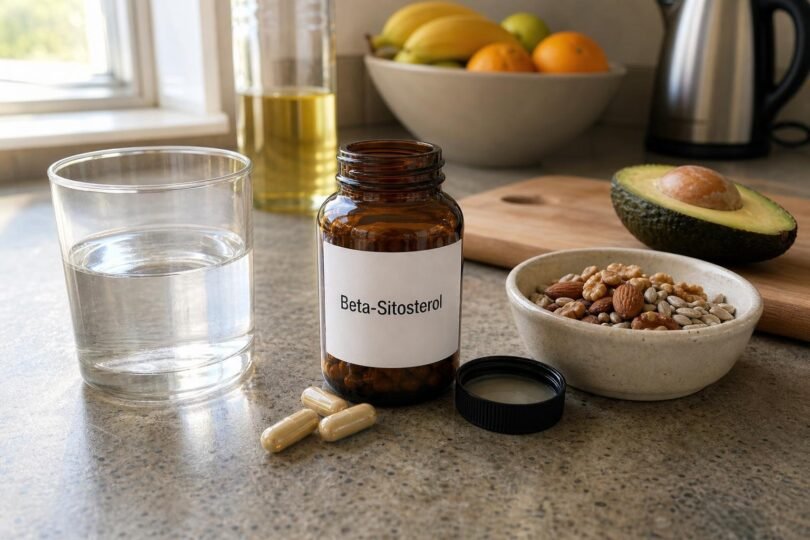
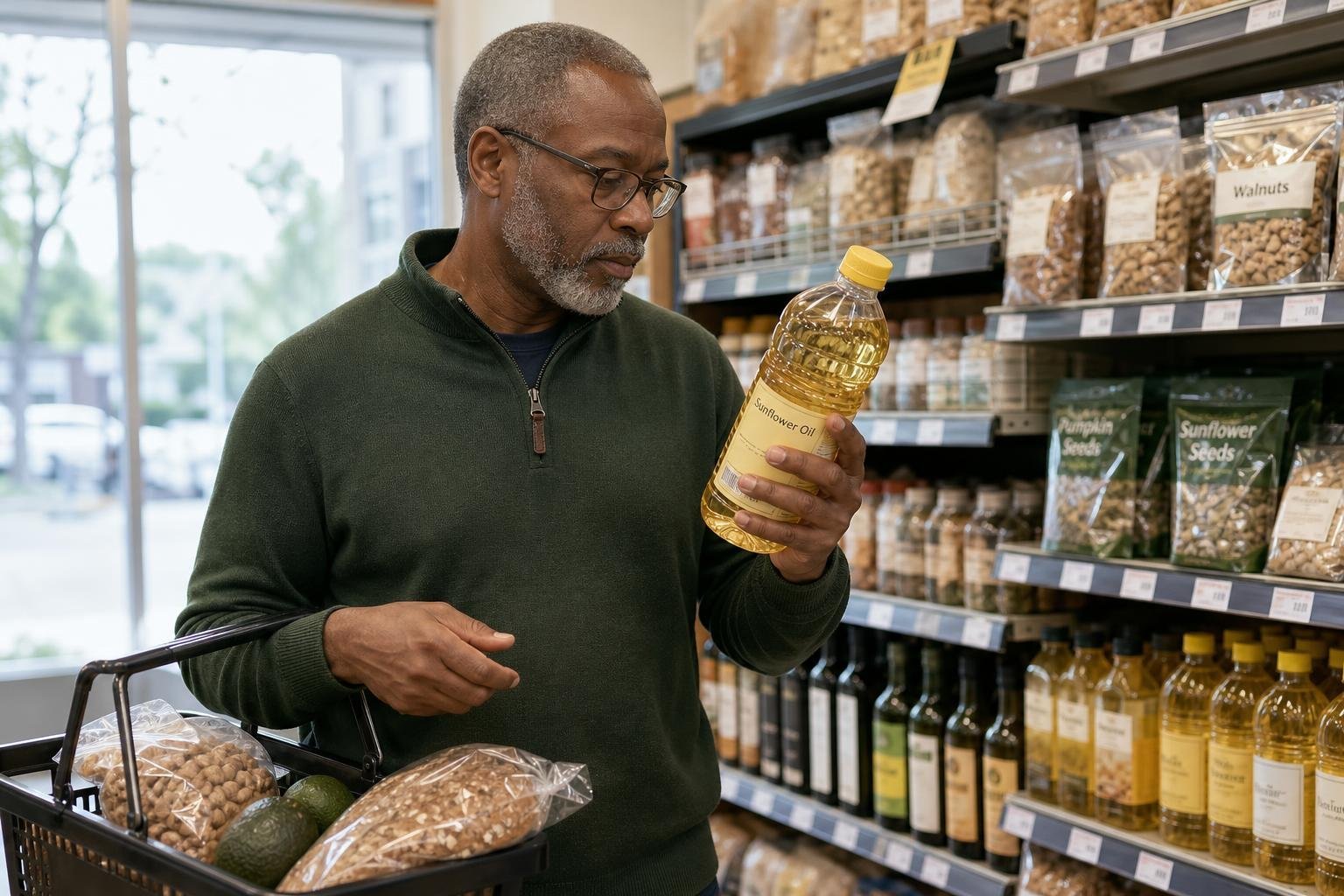
Beta-sitosterol is a phytosterol, or plant sterol: a fat-like compound that plants make and that has a structure very similar to cholesterol. Plant sterols are found naturally in vegetable oils, nuts, seeds, grain products, fruits and vegetables. A typical diet provides about 200–400 mg of plant sterols a day [1].
Beta-sitosterol is sold on its own as a capsule, as part of plant sterol blends, and in herbal extracts such as saw palmetto. Plant sterols are also added to some margarines, spreads and dairy-type foods to help lower cholesterol [1].
Because it looks so much like cholesterol, beta-sitosterol competes with cholesterol in the gut, so less cholesterol gets absorbed [2]. That is the main reason it can lower blood cholesterol.
Beta-sitosterol for an enlarged prostate (BPH)
Benign prostatic hyperplasia (BPH) is a non-cancerous enlargement of the prostate that’s common as men get older. It can cause a weak urine stream, needing to go often, and trouble emptying the bladder. This is where beta-sitosterol has its most direct human evidence.
A Cochrane systematic review (a careful pooling of all the good trials on a question) found four placebo-controlled, double-blind trials with 519 men, lasting 4 to 26 weeks [3]. Compared with a placebo (dummy pill), beta-sitosterol:
- improved symptom scores by about 4.9 points on the International Prostate Symptom Score (IPSS, a 0–35 questionnaire where lower is better), based on two trials
- raised peak urine flow by about 3.9 mL per second
- reduced the urine left in the bladder by about 29 mL
- did not shrink the prostate
The two largest trials were both German. In one, 200 men took 20 mg of beta-sitosterol three times a day (60 mg a day) or a placebo for six months; symptom scores fell by 7.4 points with beta-sitosterol versus 2.1 points with placebo [4]. In the other, 177 men took 130 mg a day for six months, and symptoms improved by 5.4 points more than with placebo [5].
There are real limits, though. The trials are old (1990s), short, and used different products, and the reviewers’ positive conclusion applies to the usual non-glucoside form of beta-sitosterol [3]. An 18-month follow-up of the 200-man trial found the benefit held in men who kept taking it, but that phase was open-label (everyone knew what they were taking), only 59% of the men were analyzed, and the authors themselves said more trials were needed before calling beta-sitosterol effective [6]. The Cochrane authors also noted that long-term effectiveness, safety and whether it prevents BPH complications are unknown [3].
If you have urinary symptoms, see a doctor first. The same symptoms can come from other problems, including prostate cancer, that need proper checks.
Does beta-sitosterol lower cholesterol?
Yes, plant sterols reliably lower LDL cholesterol (the “bad” cholesterol linked to heart disease), but the dose matters a lot.
A large meta-analysis (a study that pools results from many trials) of 124 studies found that plant sterol and stanol intakes of 0.6–3.3 grams a day lowered LDL cholesterol by about 6–12%, with the effect growing up to roughly 3 grams a day [1]. Most of these studies added the sterols to margarines, spreads or dairy-type products, and the lead authors worked for Unilever, which sells sterol-enriched spreads. A European Atherosclerosis Society expert panel reached a similar conclusion: about 2 grams a day lowers LDL by 8–10% [2].
Beta-sitosterol on its own can work at high doses, too. In a small German study of seven children with familial hypercholesterolemia (an inherited condition that causes very high cholesterol), 6 grams of sitosterol a day lowered total and LDL cholesterol by 17% compared with diet alone [7].
Two important caveats:
- Prostate-style doses are far too low. The prostate trials used 60–130 mg a day [4,5]. That’s roughly 15 to 33 times less than the 2 grams a day used for cholesterol.
- No proof yet of fewer heart attacks. The expert panel pointed out that there are no randomized trials showing plant sterols reduce heart attacks or strokes; the evidence is for lower LDL cholesterol [2].
The panel suggested sterol-enriched foods may be worth considering for people with high cholesterol who don’t need medication, and as an add-on for people already on statins who haven’t reached their target [2]. If you’re on cholesterol medicine, talk to your doctor before adding anything.
Beta-sitosterol, DHT and testosterone
Beta-sitosterol is often added to “testosterone boosters” because it may block 5-alpha reductase. That’s the enzyme that turns testosterone into dihydrotestosterone (DHT), a stronger hormone involved in prostate growth and male pattern hair loss.
The evidence for this in people is thin. The idea comes mainly from lab and animal work, such as a study in hamsters [8]. In the human prostate trials, beta-sitosterol didn’t shrink the prostate [3], so it isn’t clear that it works the same way as prescription drugs that block this enzyme. We couldn’t find any human trials showing that beta-sitosterol raises testosterone or helps build muscle or strength.
Beta-sitosterol for hair loss
Male pattern hair loss (androgenetic alopecia) is driven partly by DHT, so beta-sitosterol has been tried for it. The human evidence is very limited:
- A 2002 pilot study tested a capsule combining saw palmetto extract and beta-sitosterol in men aged 23–64 with mild to moderate hair loss. Six of the 10 men taking the active capsule were rated as improved [9]. It was tiny, and it can’t tell you whether beta-sitosterol or saw palmetto did the work.
- A 2023 placebo-controlled trial in India split 80 men and women into four groups of 20 to test a saw palmetto oil containing 2–3% beta-sitosterol, taken as a capsule or applied to the scalp, for 16 weeks. Hair shedding fell and hair density rose by about 5–8% from the start of the study, which was significantly better than placebo [10]. Several authors worked for the company that makes the product, and again it tested saw palmetto oil, not beta-sitosterol alone.
So far, there’s no good evidence that beta-sitosterol on its own helps hair loss. Proven treatments exist, so a doctor or dermatologist is a better first stop.
Beta-sitosterol side effects and safety
In the prostate trials, beta-sitosterol was generally well tolerated: 7.8% of men on beta-sitosterol dropped out compared with 8.0% on placebo [3]. A few things to know:
- Carotenoids: At about 2.5 grams a day, plant sterols lowered blood levels of beta-carotene by about 16% and of some other carotenoids (plant pigments your body uses as antioxidants or to make vitamin A) by smaller amounts. Vitamin A (retinol) and vitamin D levels didn’t change, and levels stayed within normal ranges [11].
- Sitosterolemia: People with this rare inherited condition can’t clear plant sterols properly, so sitosterol builds up in the blood and tissues and can cause early hardening of the arteries [12]. If you have it, talk to your doctor before using beta-sitosterol supplements or sterol-enriched foods.
- Long-term safety: The prostate trials lasted six months or less, so the long-term safety of beta-sitosterol capsules isn’t known [3].
If you’re pregnant or breastfeeding, take medicines, or have a medical condition, check with your doctor or pharmacist first.
The bottom line on beta-sitosterol benefits
The main beta-sitosterol benefits backed by human studies are modest. Short trials from the 1990s suggest it can ease urinary symptoms from an enlarged prostate, without shrinking the prostate. Plant sterols also lower LDL cholesterol, by about 8–10% at around 2 grams a day (up to about 12% at 3 grams), usually from fortified foods, which is far more than the doses used in the prostate trials. Claims that it boosts testosterone or reverses hair loss aren’t supported by good human evidence.
Related reading: lycopene and men’s health, what low-carb diets do to cholesterol and does ginger increase testosterone?
This article is for general information only and isn’t medical advice. Talk to your doctor or another qualified health professional before starting a new supplement. See our medical disclaimer.
References
- Ras RT, Geleijnse JM, Trautwein EA. LDL-cholesterol-lowering effect of plant sterols and stanols across different dose ranges: a meta-analysis of randomised controlled studies. Br J Nutr. 2014;112(2):214-219. doi:10.1017/S0007114514000750
- Gylling H, Plat J, Turley S, et al. Plant sterols and plant stanols in the management of dyslipidaemia and prevention of cardiovascular disease. Atherosclerosis. 2014;232(2):346-360. doi:10.1016/j.atherosclerosis.2013.11.043
- Wilt T, Ishani A, MacDonald R, Stark G, Mulrow C, Lau J. Beta-sitosterols for benign prostatic hyperplasia. Cochrane Database Syst Rev. 1999;(2):CD001043. doi:10.1002/14651858.CD001043
- Berges RR, Windeler J, Trampisch HJ, Senge T. Randomised, placebo-controlled, double-blind clinical trial of beta-sitosterol in patients with benign prostatic hyperplasia. Lancet. 1995;345(8964):1529-1532. doi:10.1016/s0140-6736(95)91085-9
- Klippel KF, Hiltl DM, Schipp B. A multicentric, placebo-controlled, double-blind clinical trial of beta-sitosterol (phytosterol) for the treatment of benign prostatic hyperplasia. Br J Urol. 1997;80(3):427-432. PubMed 9313662
- Berges RR, Kassen A, Senge T. Treatment of symptomatic benign prostatic hyperplasia with beta-sitosterol: an 18-month follow-up. BJU Int. 2000;85(7):842-846. doi:10.1046/j.1464-410x.2000.00672.x
- Becker M, Staab D, Von Bergmann K. Long-term treatment of severe familial hypercholesterolemia in children: effect of sitosterol and bezafibrate. Pediatrics. 1992;89(1):138-142. PubMed 1727999
- Cabeza M, Bratoeff E, Heuze I, Ramírez E, Sánchez M, Flores E. Effect of beta-sitosterol as inhibitor of 5 alpha-reductase in hamster prostate. Proc West Pharmacol Soc. 2003;46:153-155. PubMed 14699915
- Prager N, Bickett K, French N, Marcovici G. A randomized, double-blind, placebo-controlled trial to determine the effectiveness of botanically derived inhibitors of 5-alpha-reductase in the treatment of androgenetic alopecia. J Altern Complement Med. 2002;8(2):143-152. doi:10.1089/acm.2002.8.143
- Sudeep HV, Rashmi S, Jestin TV, Richards A, Gouthamchandra K, Shyamprasad K. Oral and topical administration of a standardized saw palmetto oil reduces hair fall and improves the hair growth in androgenetic alopecia subjects: a 16-week randomized, placebo-controlled study. Clin Cosmet Investig Dermatol. 2023;16:3251-3266. doi:10.2147/CCID.S435795
- Baumgartner S, Ras RT, Trautwein EA, Mensink RP, Plat J. Plasma fat-soluble vitamin and carotenoid concentrations after plant sterol and plant stanol consumption: a meta-analysis of randomized controlled trials. Eur J Nutr. 2017;56(3):909-923. doi:10.1007/s00394-016-1289-7
- MedlinePlus Genetics. Sitosterolemia. U.S. National Library of Medicine. medlineplus.gov/genetics/condition/sitosterolemia