


In short
The best-supported ashwagandha benefits are modest drops in stress, anxiety and the stress hormone cortisol, plus a small improvement in sleep, mostly from short trials of 8 to 12 weeks. Studies on testosterone and strength look positive but are small and often funded by supplement makers, so treat them as promising rather than proven. Ashwagandha is usually well tolerated for a few months, but rare liver injury has been reported, and some people (including pregnant women) should avoid it.
Ashwagandha is one of the most popular herbal supplements around, and it’s marketed for everything from stress to testosterone to muscle gain. So what are the real ashwagandha benefits once you look at the studies? Below we go through the evidence claim by claim, including where it’s strong, where it’s thin, and what the safety data says.
What is ashwagandha?
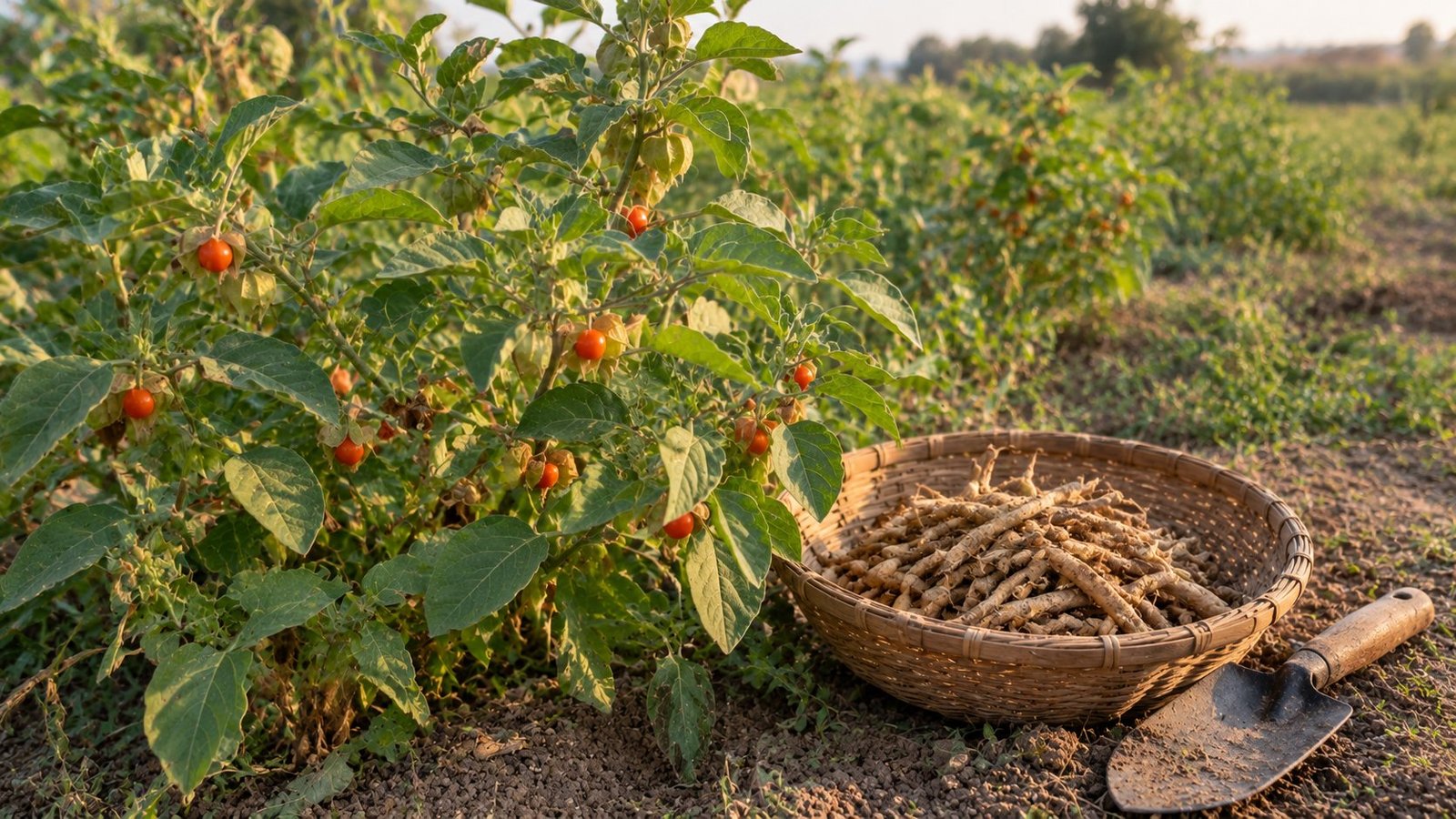
Ashwagandha (Withania somnifera) is a small shrub used for centuries in Ayurveda, the traditional medicine system of India. It’s also called winter cherry or Indian ginseng, although it isn’t related to true ginseng. The name is often explained as “smell of a horse,” because the roots are said to smell like a wet horse [1].
Most supplements use an extract of the root, and some use root and leaf together. The plant contains compounds called withanolides (steroid-like plant chemicals), which are thought to be behind many of its effects [1]. Ashwagandha is often described as an “adaptogen,” a loose term for herbs said to help the body cope with stress. It’s a marketing-friendly word rather than a medical category, so it’s worth looking at what each claim is actually based on.
Ashwagandha benefits for stress, anxiety and cortisol
This is where the evidence is strongest. In one of the better-known trials, 64 adults with chronic stress took 300 mg of a root extract twice a day for 60 days. Compared with placebo, they scored lower on several stress questionnaires and had lower blood levels of cortisol, the body’s main stress hormone [2].
A 2022 meta-analysis (a study that pools the results of many trials) combined 12 trials with about 1,000 people and found that ashwagandha reduced both stress and anxiety compared with placebo. However, the authors rated the certainty of that evidence as low, because the trials were small and their results varied a lot [3]. Benefits for stress were seen at around 300 to 600 mg a day.
Not every study agrees. A 12-week trial in stressed, overweight adults found that perceived stress improved just as much with placebo as with ashwagandha, although fatigue improved more in the ashwagandha group [4]. And a 2025 meta-analysis found that ashwagandha lowered cortisol but did not clearly lower how stressed people said they felt [5]. A lower cortisol reading is not the same thing as feeling less stressed.
The NIH Office of Dietary Supplements sums it up as promising but limited, noting that an international expert taskforce has only provisionally recommended ashwagandha for generalized anxiety disorder until more research is done [1].
Does ashwagandha help you sleep?
Its species name, somnifera, means “sleep-inducing,” and there is some support for that. A 2021 meta-analysis of five trials with 400 people found a small but real improvement in overall sleep. The effect was larger in people diagnosed with insomnia, at doses of 600 mg a day or more, and when it was taken for at least 8 weeks. No serious side effects were reported, although the authors noted that long-term safety data are limited [6].
An older, small study of 18 healthy volunteers that wasn’t placebo-controlled found that 6 of them reported better sleep while taking ashwagandha [7]. That’s interesting, but too small to tell us much on its own.
Ashwagandha and testosterone
The old version of this article said ashwagandha “increases testosterone.” The evidence suggests it may raise it a little in men, but the picture is less clear-cut than supplement labels suggest.
A 2026 meta-analysis of 23 randomized trials found that ashwagandha raised testosterone in men by about 57 ng/dL on average, with no meaningful effect in women [8]. That’s a modest change on average. In an 8-week crossover trial (where each person takes both the supplement and the placebo, one after the other) in overweight men aged 40 to 70, testosterone rose about 15% more with ashwagandha than with placebo, but the men didn’t report feeling any more energetic or any change in sexual well-being [9].
Much of the early interest came from studies in men with fertility problems. In one study of 75 infertile men in India, taking 5 g of ashwagandha root powder a day for 3 months improved sperm count and motility and raised testosterone, but it compared the men with healthy fertile men rather than with a placebo group [10]. A small placebo-controlled pilot study of 46 men with low sperm counts also reported better sperm counts and hormone levels after 90 days [11]. These results are encouraging for that specific group, but they don’t show that ashwagandha boosts testosterone in men whose levels are already normal.
If you’re curious about other herbs sold for testosterone, see our articles on Tribulus terrestris and Mucuna pruriens.
Does ashwagandha build muscle and strength?
The study most often quoted here followed 57 young men who were fairly new to weight training. Over 8 weeks of a training program, those taking 300 mg of root extract twice daily added about 46 kg to their bench press compared with about 26 kg in the placebo group, and they also gained a little more arm and chest size [12].
That sounds impressive, but it’s one study, and newer reviews are more cautious. A 2026 meta-analysis that looked only at trials combining ashwagandha with resistance training found just three trials with usable data (161 people). Strength gains looked larger with ashwagandha at first, but the result lost statistical significance under stricter analysis and relied heavily on a single trial. The authors rated the evidence as low certainty, found no reliable effect on body fat, and called for larger, independently funded trials [13].
Ashwagandha benefits for endurance and exercise
A 2026 meta-analysis of 13 trials (599 people, mostly young adults and athletes) found a small-to-moderate overall improvement in exercise performance. The most consistent benefit was for aerobic endurance, while effects on strength were positive but uncertain. Doses of 500 to 600 mg a day had the most support [14]. One of the trials included, in 50 athletic adults, found that VO2 max (a measure of how well your body uses oxygen during hard exercise) rose more with ashwagandha than with placebo over 12 weeks [15].
Bottom line for athletes: there may be a small edge, especially for endurance, but the trials are small and benefits weren’t seen in every setting. It’s not a substitute for training, sleep and good nutrition. If endurance is your goal, you might also be interested in our look at Rhodiola rosea, another herb sold as an adaptogen.
What about sex drive and erectile dysfunction?
Ashwagandha has a long history as an aphrodisiac in Ayurveda, but a 60-day trial in 86 men with erectile dysfunction caused by psychological factors found no difference between ashwagandha root powder and placebo. Neither group improved much [16].
How much ashwagandha do people take?
Doses vary a lot between products, so compare the label with what was used in studies. According to the NIH Office of Dietary Supplements [1]:
- For stress, most trials used about 225 to 600 mg a day of a root or root-and-leaf extract, with the clearest benefit at 500 to 600 mg.
- For anxiety, trials used 300 to 600 mg a day of root extract standardized to 5% withanolides.
- For sleep, doses ranged from about 120 mg to 600 mg a day.
Many of the trials tested specific branded extracts, often in studies run or funded by the companies that make them. Results from one extract don’t automatically apply to another, or to plain root powder, which is used at much higher doses (several grams a day).
Side effects and safety
For most people, ashwagandha appears to be well tolerated for up to about 3 months, but its long-term safety isn’t known [1]. The most common side effects are mild: stomach upset, loose stools, nausea and drowsiness [1]. In the small 18-person dose study, one volunteer had to stop because of vertigo and unusual effects including hallucinations [7].
Liver injury. This is rare but important. The NIH’s LiverTox database rates ashwagandha as a likely cause of liver injury. Cases usually start 2 to 12 weeks after starting the supplement, with jaundice (yellowing of the skin and eyes) and itching, and most recover within 1 to 4 months of stopping. Rare fatal cases have also been described [17]. A case series from Iceland and the US described five people with ashwagandha-related liver injury, all of whom developed jaundice [18]. Stop taking it and see a doctor if you notice dark urine, yellow skin or eyes, or unexplained itching.
Who should avoid it or check first? Based on the NIH fact sheet [1]:
- Pregnant or breastfeeding women. Some experts advise against it, and in 2024 France’s food safety agency (ANSES) recommended against use during pregnancy and breastfeeding. Denmark went further and banned ashwagandha in 2023.
- People with thyroid or other hormone conditions. Ashwagandha may change thyroid hormone levels, and a few cases of an overactive thyroid have been reported.
- Men with hormone-sensitive prostate cancer, because it might raise testosterone.
- People with liver disease, given the liver injury reports.
- People taking medicines for diabetes, blood pressure, thyroid problems, sleep or anxiety (sedatives), or that suppress the immune system, because of possible interactions.
The bottom line on ashwagandha benefits
The most believable ashwagandha benefits are modest reductions in stress, anxiety and cortisol, and a small improvement in sleep, especially for people with insomnia. A small rise in testosterone in men and a slight boost in endurance and strength are possible, but that evidence comes from small, often industry-funded trials. If you want to try it, stick to the doses used in studies, use it for weeks rather than years, and talk to your doctor first if you’re pregnant, have a thyroid or liver condition, or take regular medication.
This article is for general information only and isn’t medical advice. Talk to your doctor or another qualified health professional before starting a new supplement. See our medical disclaimer.
References
- NIH Office of Dietary Supplements. Ashwagandha: Is it helpful for stress, anxiety, or sleep? Health Professional Fact Sheet. Updated May 2, 2025. ods.od.nih.gov
- Chandrasekhar K, Kapoor J, Anishetty S. A prospective, randomized double-blind, placebo-controlled study of safety and efficacy of a high-concentration full-spectrum extract of ashwagandha root in reducing stress and anxiety in adults. Indian J Psychol Med. 2012;34(3):255-262. doi:10.4103/0253-7176.106022
- Akhgarjand C, et al. Does Ashwagandha supplementation have a beneficial effect on the management of anxiety and stress? A systematic review and meta-analysis of randomized controlled trials. Phytother Res. 2022;36(11):4115-4124. doi:10.1002/ptr.7598
- Smith SJ, Lopresti AL, Fairchild TJ. Exploring the efficacy and safety of a novel standardized ashwagandha root extract (Witholytin) in adults experiencing high stress and fatigue in a randomized, double-blind, placebo-controlled trial. J Psychopharmacol. 2023;37(11):1091-1104. doi:10.1177/02698811231200023
- Albalawi AA. Dual impact of Ashwagandha: Significant cortisol reduction but no effects on perceived stress. A systematic review and meta-analysis. Nutr Health. 2025;31(4):1395-1408. doi:10.1177/02601060251363647
- Cheah KL, Norhayati MN, Husniati Yaacob L, Abdul Rahman R. Effect of Ashwagandha (Withania somnifera) extract on sleep: A systematic review and meta-analysis. PLoS One. 2021;16(9):e0257843. doi:10.1371/journal.pone.0257843
- Raut AA, et al. Exploratory study to evaluate tolerability, safety, and activity of Ashwagandha (Withania somnifera) in healthy volunteers. J Ayurveda Integr Med. 2012;3(3):111-114. doi:10.4103/0975-9476.100168
- Fornalik M, et al. Hormonal Modulation with Withania somnifera: Systematic Review and Meta-Analysis of Randomized-controlled Trials. Planta Med. 2026;92(8):790-805. doi:10.1055/a-2802-8363
- Lopresti AL, Drummond PD, Smith SJ. A Randomized, Double-Blind, Placebo-Controlled, Crossover Study Examining the Hormonal and Vitality Effects of Ashwagandha (Withania somnifera) in Aging, Overweight Males. Am J Mens Health. 2019;13(2):1557988319835985. doi:10.1177/1557988319835985
- Ahmad MK, et al. Withania somnifera improves semen quality by regulating reproductive hormone levels and oxidative stress in seminal plasma of infertile males. Fertil Steril. 2010;94(3):989-996. doi:10.1016/j.fertnstert.2009.04.046
- Ambiye VR, et al. Clinical Evaluation of the Spermatogenic Activity of the Root Extract of Ashwagandha (Withania somnifera) in Oligospermic Males: A Pilot Study. Evid Based Complement Alternat Med. 2013;2013:571420. doi:10.1155/2013/571420
- Wankhede S, et al. Examining the effect of Withania somnifera supplementation on muscle strength and recovery: a randomized controlled trial. J Int Soc Sports Nutr. 2015;12:43. doi:10.1186/s12970-015-0104-9
- Lee JC, Heo AS. Adjunctive Ashwagandha (Withania somnifera) Supplementation and Resistance-Training Adaptations in Healthy Adults: A Systematic Review and Random-Effects Meta-Analysis of Muscular Strength, Chest Circumference, and Body Composition. Nutrients. 2026;18(17):2815. doi:10.3390/nu18172815
- Li X, et al. Effects of Withania somnifera (Ashwagandha) Supplementation on Exercise Performance: A Systematic Review and Three-Level Meta-Analysis. Nutrients. 2026;18(12):1915. doi:10.3390/nu18121915
- Choudhary B, Shetty A, Langade DG. Efficacy of Ashwagandha (Withania somnifera [L.] Dunal) in improving cardiorespiratory endurance in healthy athletic adults. Ayu. 2015;36(1):63-68. doi:10.4103/0974-8520.169002
- Mamidi P, Thakar AB. Efficacy of Ashwagandha (Withania somnifera Dunal. Linn.) in the management of psychogenic erectile dysfunction. Ayu. 2011;32(3):322-328. doi:10.4103/0974-8520.93907
- LiverTox: Clinical and Research Information on Drug-Induced Liver Injury. Ashwagandha. National Institute of Diabetes and Digestive and Kidney Diseases; updated December 3, 2024. NCBI Bookshelf NBK548536
- Björnsson HK, et al. Ashwagandha-induced liver injury: A case series from Iceland and the US Drug-Induced Liver Injury Network. Liver Int. 2020;40(4):825-829. doi:10.1111/liv.14393