


In short: Hydroxycitric acid (HCA), the main active compound in Garcinia cambogia, has been tested for weight loss in many small, short trials. Pooled results suggest it may help people lose about 1 kg (2 lb) more than a placebo over a few months, but the best-designed trials found no real difference. It’s generally well tolerated in studies, but rare cases of serious liver injury have been linked to Garcinia products.
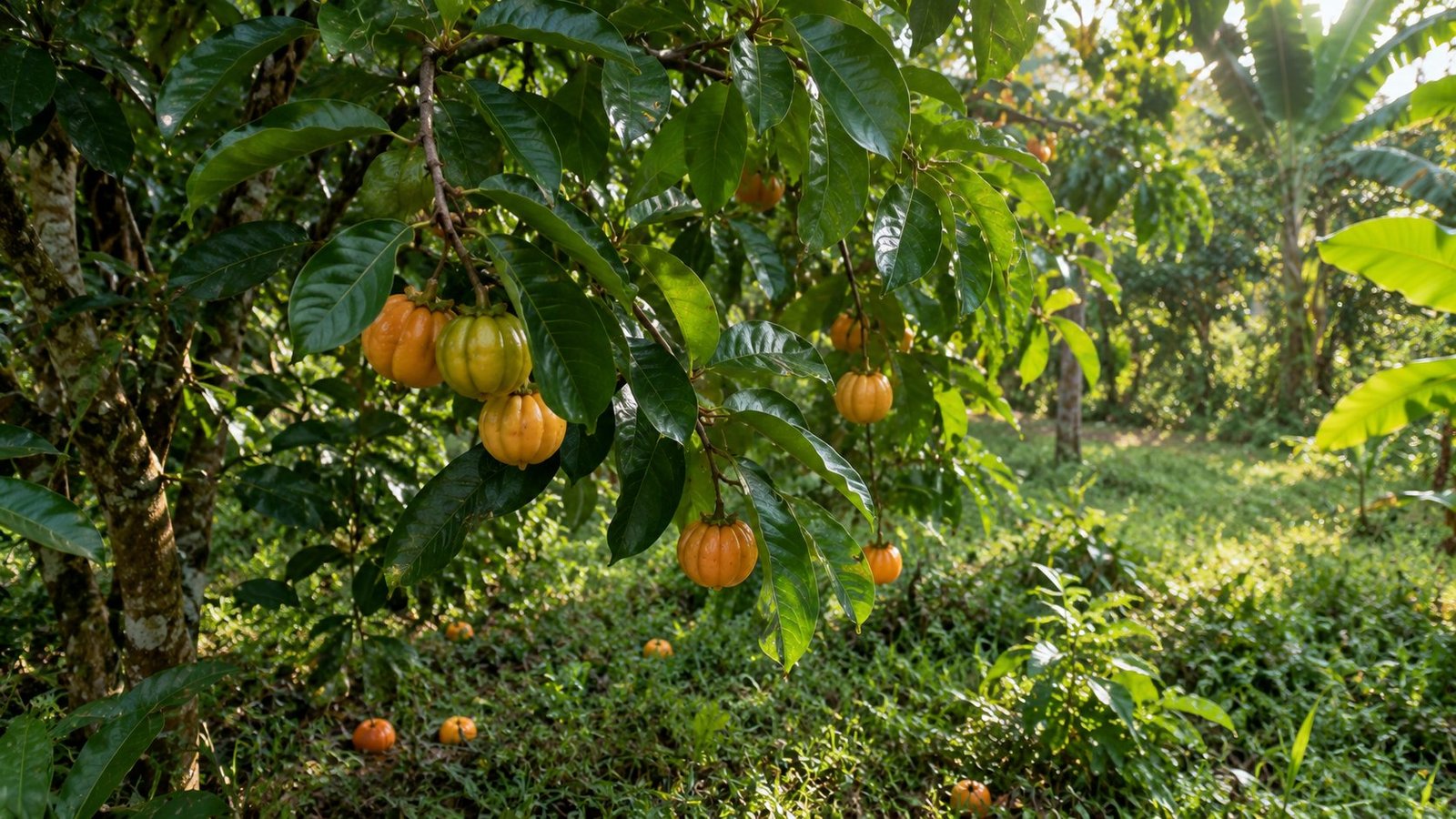
Hydroxycitric acid (HCA) is a natural acid found in the fruit rind of Garcinia cambogia, a tropical tree that grows in Asia, Africa and the Polynesian islands [1]. It’s the ingredient behind most “Garcinia” weight loss products, which are marketed to curb appetite and block fat production. Here’s what the human studies on hydroxycitric acid actually show, for weight loss, exercise and safety.
What is hydroxycitric acid?
Hydroxycitric acid is a close chemical cousin of citric acid, the acid in lemons. Garcinia cambogia (also called Malabar tamarind) and a few related Garcinia species, such as kokum (Garcinia indica), contain it in large amounts. Supplements are usually sold as “Garcinia cambogia extract” or “HCA,” and many weight loss blends include it alongside other ingredients.
The theory is neat. In the lab, HCA blocks an enzyme called ATP citrate lyase, which the body uses in the early steps of turning extra carbohydrate into fat [2]. In rats, HCA also reduced food intake and slowed weight gain [1]. The question is whether any of that matters at the doses people actually take.
Does hydroxycitric acid help you lose weight?
Probably not by much. The two best-known trials point in different directions:
- The JAMA trial (1998). 135 adults with overweight took 1,500 mg of HCA a day or a placebo for 12 weeks, alongside a low-calorie, high-fiber diet. Both groups lost weight, but there was no significant difference between them in weight or body fat [2].
- The Purdue trial (2000). 89 women with mild overweight took 1,200 mg of HCA a day before meals with a 1,200-calorie diet. They lost 3.7 kg (about 8 lb) versus 2.4 kg (about 5 lb) on placebo [3].
When researchers pool the trials together, the effect is small. A 2011 meta-analysis (a study that combines the results of several trials) found people taking HCA lost about 0.88 kg (roughly 2 lb) more than those on placebo over 2 to 12 weeks, and called the clinical relevance “uncertain” [4]. According to the NIH, that difference disappeared when only the most rigorous trials were counted [1].
A 2020 meta-analysis of eight trials (530 people) found a slightly bigger average drop of about 1.3 kg (3 lb) [5]. But another 2020 review from the University of Sydney, which looked at 54 placebo-controlled trials of herbal weight loss products, found no effect for Garcinia cambogia and concluded there wasn’t enough evidence to recommend any of the herbs it reviewed for weight loss [6].
Putting it together: if hydroxycitric acid works at all, the extra weight loss is around 1 kg over a few months, and almost all of the trials were small and short.
Does it curb appetite?
Appetite control is the main marketing claim, but it hasn’t held up in people. In the Purdue trial, the only one designed to measure this properly, HCA had no effect on hunger, fullness or how well people stuck to their diet [3].
Does hydroxycitric acid improve exercise performance?
Some sports supplements include HCA on the idea that it helps the body burn more fat during exercise and save stored carbohydrate (glycogen), delaying fatigue. The evidence is thin:
- In 10 men taking 3,000 mg a day for three days, HCA didn’t change calorie burn or fat burning at rest or during moderate exercise [7].
- In a tiny study of six untrained men, 500 mg a day for five days slightly increased fat burning during exercise [8]. One of the authors worked for a supplement company.
- In mice, HCA increased fat use and lengthened swimming time to exhaustion, but only in animals so far [9].
- In eight healthy men, 500 mg of HCA taken with a high-carb meal after cycling sped up glycogen refilling in muscle over three hours [10].
None of these studies measured actual performance in people, such as race times. A 2016 review of fat-burning supplements for endurance athletes concluded that more practical data are still needed for supplements like Garcinia [11].
Blood sugar and cholesterol
The small glycogen study above also found a lower insulin response after the meal [10]. But a 2025 meta-analysis of nine trials (444 people) found Garcinia cambogia had no significant effect on fasting blood sugar or insulin levels [12].
A 2024 meta-analysis of 14 trials reported modest drops in total cholesterol and triglycerides (blood fats) and a small rise in HDL (“good”) cholesterol, with no change in LDL cholesterol [13]. The authors noted the trials were short and varied a lot, so these results need confirming in better studies.
How much hydroxycitric acid is used in studies?
Weight loss trials have used 1,000 to 2,800 mg of HCA a day, usually split into doses taken 30 to 60 minutes before meals, for up to 12 weeks [1, 4]. Product labels vary a lot, so check how much HCA (not just “Garcinia extract”) each capsule contains. No study has tested long-term use.
Hydroxycitric acid side effects and safety
In clinical trials, side effects have generally been mild: headache, nausea, cold-like symptoms and digestive upset [1]. In one trial included in the 2011 meta-analysis, gut side effects were twice as common with HCA as with placebo [4]. A small safety study in 10 healthy men taking 3,000 mg a day for 30 days found no worrying changes in blood tests and no change in testosterone [14].
A few concerns are worth knowing about:
- Liver injury. This is rare (the NIH’s LiverTox database estimates fewer than 1 in 10,000 users) but can be serious [15]. It usually shows up as jaundice (yellowing of the skin and eyes) within weeks to a few months of starting a product, and most people recover after stopping it [15]. A US liver injury network identified 22 cases linked to Garcinia products, most of which also contained green tea extract; 91% were hospitalized, one person needed a liver transplant and one died [16]. Doctors have also reported a case of sudden liver failure requiring a transplant in a man taking a Garcinia supplement [17].
- Male fertility in animal studies. High doses of some HCA preparations caused testicular damage in rats. Germany’s Federal Institute for Risk Assessment says there isn’t enough human data to rule out a similar risk with high-dose supplements [18].
- Mania. A few cases of mania (an abnormally elevated, overactive mood) have been reported in people taking Garcinia products, possibly because HCA may affect serotonin, a brain chemical [1]. This is a particular reason for caution if you take an antidepressant or have bipolar disorder.
- Unknown long-term safety. Every trial has been short, so long-term safety hasn’t been studied [1].
Many Garcinia products are blends, so it’s often hard to tell which ingredient caused a problem [1]. If you have liver disease, drink heavily, take medications that affect the liver, or are pregnant or breastfeeding, it’s best to skip hydroxycitric acid. Stop and see a doctor straight away if you notice yellowing skin or eyes, dark urine, or unusual tiredness or stomach pain.
The bottom line
Hydroxycitric acid sounds promising on paper, but in people the extra weight loss is small (about 1 kg at best), the appetite effect hasn’t shown up, and the exercise research is mostly in tiny groups or mice. Rare but serious liver injuries mean it isn’t risk-free. If weight loss is the goal, changes to your eating and activity habits do far more, and you can read more about how your body balances energy in and energy out. We’ve looked at other popular weight loss supplements too, including green coffee extract and calcium.
Other names: HCA, hydroxycitrate, Garcinia cambogia extract, Garcinia gummi-gutta, Malabar tamarind, brindleberry, kokum (Garcinia indica) extract.
This article is for general information only and isn’t medical advice. Talk to your doctor or another qualified health professional before starting a new supplement. See our medical disclaimer.
References
- Office of Dietary Supplements, National Institutes of Health. Dietary Supplements for Weight Loss: Fact Sheet for Health Professionals (Garcinia cambogia section). ods.od.nih.gov
- Heymsfield SB, Allison DB, Vasselli JR, et al. Garcinia cambogia (hydroxycitric acid) as a potential antiobesity agent: a randomized controlled trial. JAMA. 1998;280(18):1596-1600. doi:10.1001/jama.280.18.1596
- Mattes RD, Bormann L. Effects of (-)-hydroxycitric acid on appetitive variables. Physiol Behav. 2000;71(1-2):87-94. doi:10.1016/s0031-9384(00)00321-8
- Onakpoya I, Hung SK, Perry R, Wider B, Ernst E. The use of Garcinia extract (hydroxycitric acid) as a weight loss supplement: a systematic review and meta-analysis of randomised clinical trials. J Obes. 2011;2011:509038. doi:10.1155/2011/509038
- Golzarand M, Omidian M, Toolabi K. Effect of Garcinia cambogia supplement on obesity indices: a systematic review and dose-response meta-analysis. Complement Ther Med. 2020;52:102451. doi:10.1016/j.ctim.2020.102451
- Maunder A, Bessell E, Lauche R, Adams J, Sainsbury A, Fuller NR. Effectiveness of herbal medicines for weight loss: a systematic review and meta-analysis of randomized controlled trials. Diabetes Obes Metab. 2020;22(6):891-903. doi:10.1111/dom.13973
- Kriketos AD, Thompson HR, Greene H, Hill JO. (-)-Hydroxycitric acid does not affect energy expenditure and substrate oxidation in adult males in a post-absorptive state. Int J Obes Relat Metab Disord. 1999;23(8):867-873. doi:10.1038/sj.ijo.0800965
- Tomita K, Okuhara Y, Shigematsu N, Suh H, Lim K. (-)-Hydroxycitrate ingestion increases fat oxidation during moderate intensity exercise in untrained men. Biosci Biotechnol Biochem. 2003;67(9):1999-2001. doi:10.1271/bbb.67.1999
- Ishihara K, Oyaizu S, Onuki K, Lim K, Fushiki T. Chronic (-)-hydroxycitrate administration spares carbohydrate utilization and promotes lipid oxidation during exercise in mice. J Nutr. 2000;130(12):2990-2995. doi:10.1093/jn/130.12.2990
- Cheng IS, Huang SW, Lu HC, et al. Oral hydroxycitrate supplementation enhances glycogen synthesis in exercised human skeletal muscle. Br J Nutr. 2012;107(7):1048-1055. doi:10.1017/S0007114511003862
- Kim J, Park J, Lim K. Nutrition supplements to stimulate lipolysis: a review in relation to endurance exercise capacity. J Nutr Sci Vitaminol (Tokyo). 2016;62(3):141-161. doi:10.3177/jnsv.62.141
- Tavakoli S, Amini MR, Rabiee R, et al. The effects of Garcinia cambogia on glycaemic control and liver enzymes in adults: a systematic review and meta-analysis of randomised controlled trials. J Nutr Sci. 2025;14:e8. doi:10.1017/jns.2024.91
- Amini MR, Rasaei N, Jalalzadeh M, et al. The effects of Garcinia cambogia (hydroxycitric acid) on lipid profile: a systematic review and meta-analysis of randomized controlled trials. Phytother Res. 2024;38(2):1028-1043. doi:10.1002/ptr.8102
- Hayamizu K, Ishii Y, Shigematsu N, et al. Safety of Garcinia cambogia extract in healthy men: high-doses administration study I. J Oleo Sci. 2003;52(9):499-504. doi:10.5650/jos.52.499
- LiverTox: Clinical and Research Information on Drug-Induced Liver Injury. Garcinia cambogia. National Institute of Diabetes and Digestive and Kidney Diseases; updated 2019. ncbi.nlm.nih.gov/books/NBK548087
- Vuppalanchi R, Bonkovsky HL, Ahmad J, et al. Garcinia cambogia, either alone or in combination with green tea, causes moderate to severe liver injury. Clin Gastroenterol Hepatol. 2022;20(6):e1416-e1425. doi:10.1016/j.cgh.2021.08.015
- Lunsford KE, Bodzin AS, Reino DC, Wang HL, Busuttil RW. Dangerous dietary supplements: Garcinia cambogia-associated hepatic failure requiring transplantation. World J Gastroenterol. 2016;22(45):10071-10076. doi:10.3748/wjg.v22.i45.10071
- Bakhiya N, Ziegenhagen R, Hirsch-Ernst KI, et al. Phytochemical compounds in sport nutrition: synephrine and hydroxycitric acid (HCA) as examples for evaluation of possible health risks. Mol Nutr Food Res. 2017;61(6). doi:10.1002/mnfr.201601020