

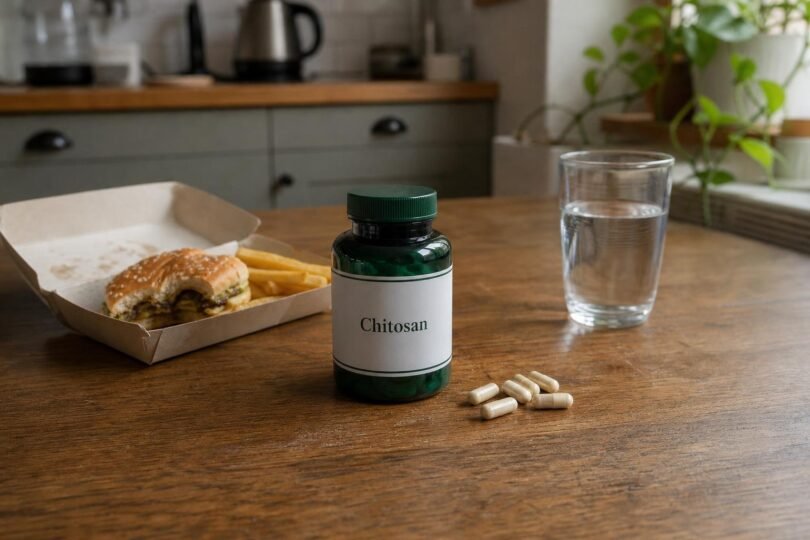
Chitosan is sold as a “fat binder”: take a few capsules before a meal, the ads say, and some of the fat you eat will pass straight through you. So does chitosan weight loss actually happen in real people? We looked at the controlled trials, the reviews that pooled them, and the studies that measured how much fat chitosan really traps.
Summary
The short version: chitosan weight loss is small at best. Pooled trials suggest people lose about 1–2 kg (2–4 lb) more than with a placebo, but the best-run trials found much less, often too little to matter. Studies that measured fat in stool found chitosan traps only a gram or two of fat a day. It may lower cholesterol a little, and side effects are usually mild stomach upsets.
What is chitosan?
Chitosan is a type of fiber made from chitin, the tough material in the shells of shrimp, crabs and other crustaceans. Manufacturers treat chitin to turn it into chitosan. The idea behind the supplement is that chitosan binds to some of the fat in your gut, so less of it gets absorbed, and it may also reduce how much cholesterol you absorb [1].
Some products are made from fungi instead of shellfish (one of the trials below tested a fungal chitosan). Either way, the marketing claim is the same: chitosan is meant to “block” fat from your meals.

How much fat does chitosan really trap?
If chitosan works the way it’s advertised, people taking it should have more fat in their stool. Researchers at the University of California, Davis tested exactly that in three small studies.
- Pilot study (7 men): the men ate a high-fat diet and took 5.25 g of chitosan a day, as the label directed. Chitosan had been advertised as able to block up to 120 g of fat a day. Fat in their stool didn’t change at all [2].
- 15 men, 4.5 g a day: chitosan increased fat in the stool by about 1.1 g a day. That’s roughly 10 calories a day, which the authors called “clinically negligible” [3].
- 12 men and 12 women, 2.5 g a day: men excreted about 1.8 g more fat a day; women excreted no extra fat. The authors worked out that a man would need more than 7 months to lose 1 pound of body fat this way [4].
These were short, small studies, but they all point the same way: whatever chitosan does, it doesn’t soak up anything close to the amount of fat the marketing suggests.
Chitosan weight loss: what the trials show
Many placebo-controlled trials have tested chitosan for weight loss, and several research teams have pooled them in meta-analyses (studies that combine the results of many trials).
The Cochrane team’s reviews. A 2005 review by the Cochrane authors, published in Obesity Reviews, pooled 14 trials (1,071 people) It found chitosan users lost about 1.7 kg more than people taking a placebo. But when the researchers looked only at the higher-quality trials, the difference shrank to 0.6 kg and was no longer statistically significant (it could have been due to chance); the lower-quality trials showed 2.3 kg [5]. The 2008 Cochrane update, with 15 trials and 1,219 people, reached the same conclusion. It also found no clear difference in stool fat between chitosan and placebo. Chitosan may help a little in the short term, but in the best trials “the effect of chitosan on body weight is minimal and unlikely to be of clinical significance” [6].
The biggest single trial. In a 24-week study at the University of Auckland, 250 adults with overweight or obesity took 3 g of chitosan a day or a placebo, and everyone got the same diet and lifestyle advice. The chitosan group lost 0.4 kg on average while the placebo group gained 0.2 kg, a difference of about 0.6 kg (1.3 lb) over almost six months. The authors concluded chitosan “did not result in a clinically significant loss of body weight” [7].
Newer meta-analyses. Two later analyses landed in a similar place. One pooled 15 trials (1,130 people) and found about 0.9 kg more weight loss and 0.7 percentage points less body fat with chitosan [8]. Another, of 14 trials, found about 1 kg more weight loss over up to a year [9]. Both found a statistically significant effect of around 1 kg; one team called it slight [9], while the other was more upbeat about chitosan as an add-on for weight management [8]. Neither changes what the higher-quality trials show.
Industry-linked trials. Some studies report bigger results. For example, a 90-day trial in 96 people in India found about 3 kg of weight loss with a chitosan made from fungi, compared with little change on placebo. But it was only single-blind (only one side, not both, was kept in the dark about who got what), and two of the authors worked for the company that makes that chitosan [10]. Results like this need confirming in independent, double-blind trials.
Put together, the honest answer is that chitosan weight loss, if it happens at all, is around a kilogram or two over several months, and less in the most careful studies. Your overall diet and activity level are likely to matter much more. For more on what drives body weight, see our guide to energy homeostasis.
Does chitosan lower cholesterol?
This is where the evidence looks a little better, though the effect is still modest.
- The 2008 Cochrane review found total cholesterol fell by about 0.2 mmol/L (roughly 8 mg/dL) more with chitosan than placebo, though better-quality trials showed smaller drops [6].
- A 2018 pooled analysis of 14 trials (1,108 people) found total and LDL (“bad”) cholesterol each fell by about 0.2 mmol/L (roughly 8 mg/dL), with no change in HDL (“good”) cholesterol or triglycerides [11].
- An earlier meta-analysis of 6 trials in people with high cholesterol (416 people) found total cholesterol fell by about 12 mg/dL, but LDL didn’t change significantly [12].
- In a 12-week German trial in 116 people with overweight or obesity taking 3.2 g a day, LDL cholesterol fell by 5.6% with chitosan versus 0.9% with placebo [13].
A drop of around 5–6% is modest. If cholesterol is your main concern, our article on beta-sitosterol and plant sterols covers another option with more research behind it, and your doctor can help you weigh the choices.
Blood pressure and blood sugar
Results for blood pressure are mixed. The 2008 Cochrane review [6] and a 2018 meta-analysis [9] found small drops of about 2–3 mmHg, but a 2017 pooled analysis of 8 trials (617 people) found no significant change overall, apart from a small drop in diastolic pressure (the lower number) in a few short, higher-dose trials [14]. Another meta-analysis of 10 trials (1,473 people, mostly with metabolic syndrome or related problems) found a small reduction in fasting blood sugar and in HbA1c (a measure of average blood sugar over the past few months), but no change in insulin, and the authors said more research is needed [15]. None of this means chitosan can treat high blood pressure or diabetes.
Chitosan side effects and safety
According to the NIH Office of Dietary Supplements, chitosan’s side effects are usually minor and mostly affect the gut: gas, bloating, mild nausea, constipation, indigestion and heartburn. It reports few safety concerns at doses of 0.24–15 g a day for up to 6 months [1].
- Shellfish allergy: because most chitosan comes from crustacean shells, people with a shellfish allergy could, in theory, react to it [1]. If you have a shellfish allergy, check with your doctor first.
- Fat-soluble vitamins: because chitosan binds fat, it may affect absorption of vitamins A, D, E and K [16]. The 24-week Auckland trial didn’t find differences in fat-soluble vitamin levels [7], but longer-term data are limited.
- Warfarin: in one case report, an 83-year-old man on the blood thinner warfarin had his blood become much thinner (a raised INR) twice after taking chitosan, probably because it reduced his vitamin K absorption [16]. If you take warfarin or another blood thinner, talk to your doctor before trying chitosan.
The bottom line on chitosan weight loss
Chitosan doesn’t trap anywhere near as much fat as its ads suggest, and the best trials show chitosan weight loss of well under a kilogram (about 1 lb), too small to make a real difference for most people. It may nudge cholesterol down slightly, and it’s generally well tolerated, but it isn’t a way to “cancel out” a cheat meal. If you’re comparing weight loss supplements, our reviews of green coffee extract and hydroxycitric acid (Garcinia) found a similar story: small effects at best.
This article is for general information only and isn’t medical advice. Talk to your doctor or another qualified health professional before starting a new supplement. See our medical disclaimer.
References
- National Institutes of Health, Office of Dietary Supplements. Dietary Supplements for Weight Loss: Fact Sheet for Health Professionals. ods.od.nih.gov
- Gades MD, Stern JS. Chitosan supplementation does not affect fat absorption in healthy males fed a high-fat diet, a pilot study. Int J Obes Relat Metab Disord. 2002;26(1):119-122. doi:10.1038/sj.ijo.0801859
- Gades MD, Stern JS. Chitosan supplementation and fecal fat excretion in men. Obes Res. 2003;11(5):683-688. doi:10.1038/oby.2003.97
- Gades MD, Stern JS. Chitosan supplementation and fat absorption in men and women. J Am Diet Assoc. 2005;105(1):72-77. doi:10.1016/j.jada.2004.10.004
- Mhurchu CN, Dunshea-Mooij C, Bennett D, Rodgers A. Effect of chitosan on weight loss in overweight and obese individuals: a systematic review of randomized controlled trials. Obes Rev. 2005;6(1):35-42. doi:10.1111/j.1467-789X.2005.00158.x
- Jull AB, Ni Mhurchu C, Bennett DA, Dunshea-Mooij CA, Rodgers A. Chitosan for overweight or obesity. Cochrane Database Syst Rev. 2008;(3):CD003892. doi:10.1002/14651858.CD003892.pub3
- Mhurchu CN, Poppitt SD, McGill AT, et al. The effect of the dietary supplement, Chitosan, on body weight: a randomised controlled trial in 250 overweight and obese adults. Int J Obes Relat Metab Disord. 2004;28(9):1149-1156. doi:10.1038/sj.ijo.0802693
- Huang H, Liao D, Zou Y, Chi H. The effects of chitosan supplementation on body weight and body composition: a systematic review and meta-analysis of randomized controlled trials. Crit Rev Food Sci Nutr. 2020;60(11):1815-1825. doi:10.1080/10408398.2019.1602822
- Moraru C, Mincea MM, Frandes M, Timar B, Ostafe V. A meta-analysis on randomised controlled clinical trials evaluating the effect of the dietary supplement chitosan on weight loss, lipid parameters and blood pressure. Medicina (Kaunas). 2018;54(6):109. doi:10.3390/medicina54060109
- Trivedi VR, Satia MC, Deschamps A, et al. Single-blind, placebo controlled randomised clinical study of chitosan for body weight reduction. Nutr J. 2016;15:3. doi:10.1186/s12937-016-0122-8
- Huang H, Zou Y, Chi H, Liao D. Lipid-modifying effects of chitosan supplementation in humans: a pooled analysis with trial sequential analysis. Mol Nutr Food Res. 2018;62(8):e1700842. doi:10.1002/mnfr.201700842
- Baker WL, Tercius A, Anglade M, White CM, Coleman CI. A meta-analysis evaluating the impact of chitosan on serum lipids in hypercholesterolemic patients. Ann Nutr Metab. 2009;55(4):368-374. doi:10.1159/000258633
- Lütjohann D, Marinova M, Wolter K, et al. Influence of chitosan treatment on surrogate serum markers of cholesterol metabolism in obese subjects. Nutrients. 2018;10(1):72. doi:10.3390/nu10010072
- Huang H, Zou Y, Chi H. Quantitative assessment of the effects of chitosan intervention on blood pressure control. Drug Des Devel Ther. 2017;12:67-75. doi:10.2147/DDDT.S148064
- Guo W, Yi L, Zhou B, Li M. Chitosan modifies glycemic levels in people with metabolic syndrome and related disorders: meta-analysis with trial sequential analysis. Nutr J. 2020;19(1):130. doi:10.1186/s12937-020-00647-4
- Huang SS, Sung SH, Chiang CE. Chitosan potentiation of warfarin effect. Ann Pharmacother. 2007;41(11):1912-1914. doi:10.1345/aph.1K173