
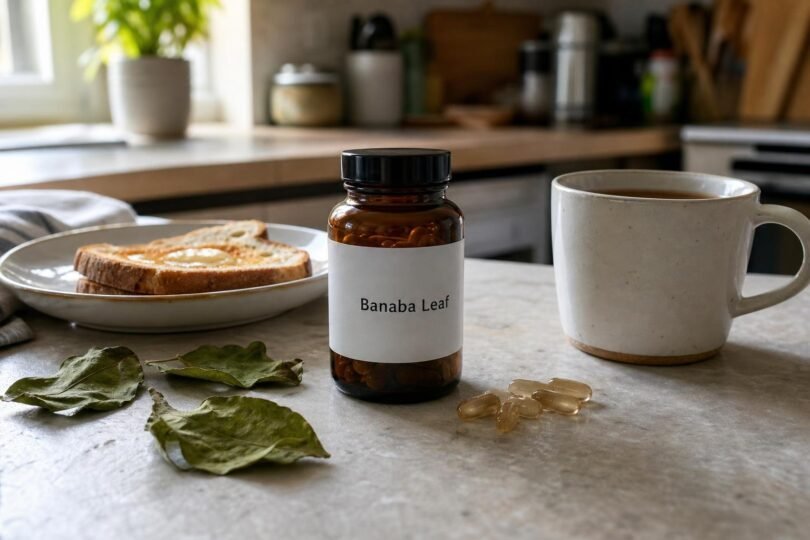
Corosolic acid is a plant compound sold mainly as a “blood sugar support” supplement, usually in the form of banaba leaf extract. Some labels also promise weight loss, lower cholesterol and even cortisol control. So what does the research on corosolic acid actually show? Here’s an honest look at the human studies, how small they are, and what’s still only been seen in mice or lab dishes.
Summary
A handful of small, short human studies suggest corosolic acid and banaba leaf extract may modestly lower blood sugar, but there are no large or long-term trials, and the products tested varied a lot. Claims about weight loss, cholesterol and cortisol rest on weak evidence or none at all. If you take diabetes medicine or have kidney problems, talk to your doctor before trying it.
What is corosolic acid?
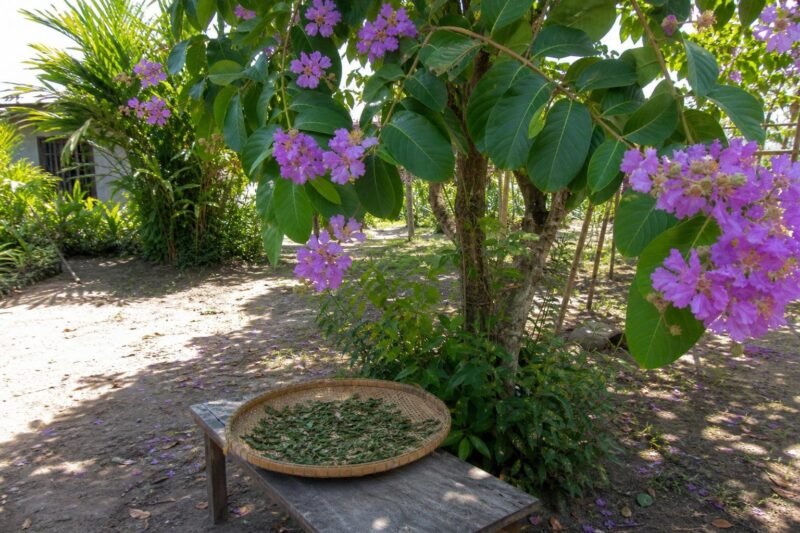
Corosolic acid is a triterpene, a type of natural compound plants make, and it’s chemically very close to ursolic acid. Supplements usually get it from the leaves of the banaba tree (Lagerstroemia speciosa), a flowering tree from Southeast Asia whose leaves have long been used in folk medicine for diabetes. The first published research on banaba appeared in 1940 [1].
Banaba supplements are often “standardized,” meaning the maker adjusts the extract so each dose contains a set percentage of corosolic acid, for example 1% in one of the trials described below. Researchers think corosolic acid isn’t the only active ingredient: banaba leaves also contain ellagitannins, a group of plant compounds that may affect blood sugar too [1].
How corosolic acid is thought to work
Most of what we know about how corosolic acid might work comes from cells and animals, not people:
- In lab-grown muscle cells, it increased glucose (sugar) uptake. In other engineered lab cells, it helped move GLUT4, the protein that carries glucose into cells, to the cell surface. In test-tube enzyme experiments, it also blocked several enzymes, including one called PTP1B, that normally dampen insulin’s signal [2].
- In a strain of diabetic mice, a single dose of 2 mg per kilogram of body weight lowered blood sugar within 4 hours and seemed to make the mice more sensitive to insulin [3].
- Reviews also describe lab and animal findings suggesting it may slow the breakdown of starches and table sugar in the gut and reduce the amount of new sugar the liver makes [1].
These results explain why researchers are interested, but effects in cells and mice often don’t carry over to people.
Corosolic acid and blood sugar: what human studies show
There are only a few human studies, and none are large.
A single dose before a sugar drink. In a Japanese study, 31 people (19 with diabetes, 8 with milder blood sugar problems and 4 with normal blood sugar) took 10 mg of pure corosolic acid or a placebo (a dummy capsule) on separate days, 5 minutes before drinking 75 g of glucose. Neither they nor the researchers knew which capsule was which (double-blind). Blood sugar was lower after corosolic acid from 60 to 120 minutes, but the difference was only statistically significant (unlikely to be due to chance) at the 90-minute mark [4].
Two weeks of banaba extract in type 2 diabetes. A 2003 randomized trial gave people with type 2 diabetes 32 or 48 mg a day of a banaba extract standardized to 1% corosolic acid, so roughly a third to half a milligram of corosolic acid itself. Blood sugar fell significantly after 2 weeks, by about 30% with a softgel version and 20% with a dry-powder capsule [5]. The study’s summary doesn’t describe a placebo group or say how many people took part, and the authors worked at a private research company, so it’s hard to judge how much of the drop the extract caused.
Twelve weeks in prediabetes. A Korean randomized trial in overweight adults with mildly high fasting blood sugar compared a placebo with 300 mg a day of banaba extract (0.3% corosolic acid) and with a soybean leaf extract, which was the study’s main focus. After 12 weeks, the banaba group had lower blood sugar, HbA1c (a measure of average blood sugar over about three months) and insulin resistance (a sign the body isn’t responding well to insulin) than the placebo group [6].
Twelve weeks in metabolic syndrome. In a small double-blind trial from Mexico, 24 people with metabolic syndrome (a cluster of problems such as high blood sugar, blood pressure, blood fats and belly fat) took 500 mg of banaba twice a day or a placebo for 12 weeks, 12 people per group. In the banaba group, fasting blood sugar dropped slightly, from 5.9 to 5.7 mmol/L (about 106 to 103 mg/dL), along with systolic blood pressure, triglycerides (a type of blood fat) and insulin levels after a glucose drink. Eight of the 12 no longer met the criteria for metabolic syndrome by the end [7]. Most of these results are changes compared with each person’s own starting point, which is weaker evidence than a clear difference from placebo.
Mixed products. Many supplements combine banaba with other ingredients, which makes its own effect impossible to pin down. A 24-week Korean trial of a mix of ginseng, mulberry leaf and banaba found no difference in blood sugar control compared with placebo [8]. An Italian trial in 148 people with mildly high blood sugar found that a tablet combining berberine, curcumin, inositol, banaba and chromium improved blood sugar compared with placebo, but there’s no way to know what part banaba played, and one of the authors worked for a supplement company [9].
A 2012 review concluded that banaba and corosolic acid “may be beneficial” for problems linked to metabolic syndrome [1]. That’s a fair description of a promising idea, but we couldn’t find any meta-analysis (a study that pools results from many trials) or any trial lasting longer than about six months. No study has shown that corosolic acid prevents diabetes or its complications.
Does corosolic acid help with weight loss?
The evidence is thin. In the Korean prediabetes trial, body weight and BMI (body mass index) didn’t differ between the banaba and placebo groups, though body fat and waist size were lower with banaba [6]. A 30-person pilot study of a slow-release tablet combining banaba, green coffee bean extract, moringa and vitamin D reported fat loss, but it had no placebo group of its own (it was compared with a placebo group from an earlier study), and the product had several ingredients. Two of its authors also wrote the 2012 review, and one worked for a private research company [10].
An older version of this article mentioned a 3-pound weight loss in 12 people over 2 weeks. That figure came from a small Japanese study we couldn’t find in any major research database, so we no longer rely on it. If weight loss is your goal, see our guides to hydroxycitric acid (Garcinia) and how your body regulates weight.
Cholesterol, cortisol and other corosolic acid claims
Cholesterol and blood fats. Triglycerides were lower with banaba in both the Korean and Mexican trials [6, 7], but in the Korean trial total and LDL (“bad”) cholesterol didn’t differ from placebo [6].
Cortisol. The old version of this article said corosolic acid “may prevent excessive cortisol production.” That claim was sourced to a company web page, not a study, and we found no human research on corosolic acid and cortisol, so we’ve removed it.
Cancer and inflammation. Corosolic acid has slowed the growth of cancer cells and reduced inflammation in lab and animal studies [11], but it hasn’t been tested as a cancer treatment in people.
Corosolic acid doses used in studies
There’s no official recommended dose. The human studies used very different products:
- 10 mg of pure corosolic acid as a single dose before a glucose drink [4]
- 32–48 mg a day of banaba extract standardized to 1% corosolic acid, for 2 weeks [5]
- 300 mg a day of banaba extract (0.3% corosolic acid), for 12 weeks [6]
- 500 mg of banaba twice a day, for 12 weeks [7]
Because the amount of corosolic acid varies so much between products, check the label for both the extract amount and its corosolic acid percentage.
Side effects and safety
A 2012 review reports no side effects in the published animal studies and controlled human trials [1], but those trials were small and lasted weeks, not years. A few points to keep in mind:
- Kidney problems: a 2010 case report described acute kidney injury and lactic acidosis (a dangerous build-up of acid in the blood) in a man with existing kidney disease who had taken corosolic acid; the painkiller diclofenac was also involved [12]. If you have kidney disease, talk to your doctor before taking it.
- Diabetes medicines: because corosolic acid may lower blood sugar, combining it with diabetes medicines could in theory push blood sugar too low. Check with your doctor first and keep monitoring your blood sugar.
- Lab toxicity: a 2025 study noted that corosolic acid showed notable toxicity in test-tube experiments, dissolves poorly in water and isn’t handled well by the body, which is why chemists are trying to design modified versions [13]. What this means for people taking supplements isn’t known.
- Pregnancy and breastfeeding: we found no safety studies, so it’s best avoided unless your doctor says otherwise.
Supplements like corosolic acid shouldn’t replace diet, exercise or prescribed diabetes treatment. For another blood sugar supplement with a similar story, see our article on vanadium supplements.
The bottom line on corosolic acid
Corosolic acid and banaba leaf extract look interesting in lab and animal research, and a few small human studies suggest a modest drop in blood sugar. But the trials are tiny, short and used different products, and there’s no good evidence that corosolic acid helps with weight loss, cholesterol or cortisol. If you’re curious about trying it, especially if you have diabetes or kidney problems, speak with your doctor first.
This article is for general information only and isn’t medical advice. Talk to your doctor or another qualified health professional before starting a new supplement. See our medical disclaimer.
References
- Stohs SJ, Miller H, Kaats GR. A review of the efficacy and safety of banaba (Lagerstroemia speciosa L.) and corosolic acid. Phytother Res. 2012;26(3):317–324. doi:10.1002/ptr.3664
- Shi L, Zhang W, Zhou YY, et al. Corosolic acid stimulates glucose uptake via enhancing insulin receptor phosphorylation. Eur J Pharmacol. 2008;584(1):21–29. doi:10.1016/j.ejphar.2008.01.020
- Miura T, Ueda N, Yamada K, et al. Antidiabetic effects of corosolic acid in KK-Ay diabetic mice. Biol Pharm Bull. 2006;29(3):585–587. doi:10.1248/bpb.29.585
- Fukushima M, Matsuyama F, Ueda N, et al. Effect of corosolic acid on postchallenge plasma glucose levels. Diabetes Res Clin Pract. 2006;73(2):174–177. doi:10.1016/j.diabres.2006.01.010
- Judy WV, Hari SP, Stogsdill WW, et al. Antidiabetic activity of a standardized extract (Glucosol) from Lagerstroemia speciosa leaves in Type II diabetics. A dose-dependence study. J Ethnopharmacol. 2003;87(1):115–117. doi:10.1016/s0378-8741(03)00122-3
- Choi MS, Ryu R, Seo YR, et al. The beneficial effect of soybean (Glycine max (L.) Merr.) leaf extracts in adults with prediabetes: a randomized placebo controlled trial. Food Funct. 2014;5(7):1621–1630. doi:10.1039/c4fo00199k
- López-Murillo LD, González-Ortiz M, Martínez-Abundis E, et al. Effect of Banaba (Lagerstroemia speciosa) on metabolic syndrome, insulin sensitivity, and insulin secretion. J Med Food. 2022;25(2):177–182. doi:10.1089/jmf.2021.0039
- Kim HJ, Yoon KH, Kang MJ, et al. A six-month supplementation of mulberry, Korean red ginseng, and banaba decreases biomarkers of systemic low-grade inflammation in subjects with impaired glucose tolerance and type 2 diabetes. Evid Based Complement Alternat Med. 2012;2012:735191. doi:10.1155/2012/735191
- Derosa G, D’Angelo A, Vanelli A, Maffioli P. An evaluation of a nutraceutical with berberine, curcumin, inositol, banaba and chromium picolinate in patients with fasting dysglycemia. Diabetes Metab Syndr Obes. 2020;13:653–661. doi:10.2147/DMSO.S232791
- Stohs SJ, Kaats GR, Preuss HG. Safety and efficacy of banaba-Moringa oleifera-green coffee bean extracts and vitamin D3 in a sustained release weight management supplement. Phytother Res. 2016;30(4):681–688. doi:10.1002/ptr.5577
- Zhao J, Zhou H, An Y, Shen K, Yu L. Biological effects of corosolic acid as an anti-inflammatory, anti-metabolic syndrome and anti-neoplasic natural compound. Oncol Lett. 2021;21(2):84. doi:10.3892/ol.2020.12345
- Zheng JQ, Zheng CM, Lu KC. Corosolic acid-induced acute kidney injury and lactic acidosis in a patient with impaired kidney function. Am J Kidney Dis. 2010;56(2):419–420. doi:10.1053/j.ajkd.2010.06.002
- Huang G, Lin Y, Zhao J, et al. Corosolic acid and its derivatives targeting MCCC1 against insulin resistance and their hypoglycemic effect on type 2 diabetic mice. Eur J Med Chem. 2025;284:117184. doi:10.1016/j.ejmech.2024.117184