

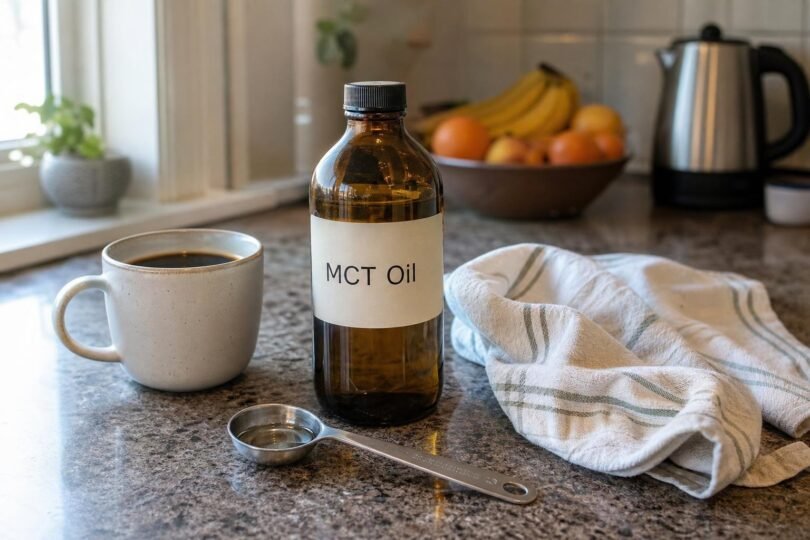
Summary: MCT oil weight loss claims rest on a real but small effect. When people swap some of their usual fat for MCT oil, trials find they lose about half a kilogram to 1.5 kg (1–3 lb) more over a few months, and one major review found signs of commercial bias in the research. MCT oil doesn’t reliably improve exercise performance, large doses can upset your stomach, and coconut oil isn’t a substitute.
MCT oil weight loss is one of the most popular reasons people add MCT oil to coffee, smoothies and shakes. The idea is that medium-chain triglycerides are burned for energy faster than other fats, so fewer calories get stored. There’s some truth to that, but the effect on the scale is much smaller than the marketing suggests. Here’s what the research shows.
What is MCT oil?
A triglyceride is the main form of fat in food and in your body: three fatty acids (chains of carbon atoms) attached to a backbone called glycerol. Medium-chain triglycerides (MCTs) are made mostly of fatty acids with 8 or 10 carbons (caprylic and capric acid), with smaller amounts of 6- and 12-carbon fatty acids [1]. Most fats in our diet are long-chain triglycerides (LCTs), which have longer chains.
MCTs are found naturally in coconut oil, palm kernel oil and milk fat, and MCT oil sold as a supplement is made by processing these fats or building MCTs chemically [2]. MCTs are also widely used in medical nutrition, including feeding through a drip for people who need supplemental nutrition [1].
Is coconut oil the same thing? No. Coconut oil is more than 90% saturated fat, and roughly half of it is lauric acid, a 12-carbon fatty acid [3]. MCT oil sold for weight loss is mostly the shorter 8- and 10-carbon kinds. In a test-meal study, people ate less at lunch after a breakfast made with MCT oil than after one made with coconut oil or a vegetable oil, and MCT oil kept them fuller over the morning; the researchers concluded coconut oil can’t be promoted as having the same effects as MCT oil [4]. A 2022 review of randomized trials found that coconut oil didn’t help with weight, waist size or body fat compared with other oils [3].

Why might MCT oil help with weight loss?
Medium-chain fatty acids are handled differently from long-chain fats: they’re readily burned for energy in the liver [5]. In studies, this faster burning slightly increases energy expenditure (the calories your body uses) compared with long-chain fats, and MCTs may make people feel full sooner [5].
But the extra calories burned are small. In one randomized study, 24 overweight men ate diets made with an MCT-rich “functional oil” (a blend that also contained plant sterols and flaxseed oil) or with olive oil for 28 days each (a crossover design, where everyone tries both diets). Energy expenditure was slightly higher with the functional oil on day 2, but by day 28 the difference was no longer statistically significant (meaning it could easily have been due to chance) [6]. The men lost a little more fat from the upper body on the functional oil (about 0.67 kg vs 0.02 kg), though because the oil was a blend, this can’t be put down to MCTs alone [6].
MCT oil weight loss: what the trials show
The best way to judge a supplement is a meta-analysis, a study that pools the results of many trials. Several have looked at MCTs:
- A 2015 meta-analysis of 13 randomized trials with 749 adults found that replacing long-chain fats with MCTs lowered body weight by about 0.5 kg (about 1 lb) more over the trial periods, and also slightly reduced waist size and body fat. The authors noted that many trials lacked the details needed to judge their quality, that they detected commercial bias (signs that industry involvement may have skewed results), and that independent, larger studies were needed [7].
- A second 2015 meta-analysis of 11 trials found a similar result: about 0.7 kg (1.5 lb) more weight lost, plus about 0.9 kg less body fat. The overall quality of the evidence was rated low to moderate, and the authors said the advice to swap in MCTs “must be cautiously taken” [8].
- A 2024 meta-analysis in people with overweight or obesity found that diets enriched with MCTs led to about 1.5% more weight loss than diets with long-chain fats. That’s roughly 1.4 kg (3 lb) for someone who weighs 90 kg (198 lb). Products that mix medium- and long-chain fats didn’t make a significant difference [9].
Two individual trials stand out. In a US study, 49 overweight adults followed a 16-week weight loss program with weekly counseling and took 18–24 grams a day (roughly 1 to 2 tablespoons) of MCT oil or olive oil. Only 31 finished. Among those who finished, the MCT oil group ended up about 1.67 kg (3.7 lb) lighter than the olive oil group, while the difference in fat loss was only a trend [10]. In a 12-week double-blind trial in Japan (neither the volunteers nor the researchers knew who got which oil), 78 adults ate foods made with MCTs or ordinary fats. The MCT group lost more weight and body fat, but only among people with a body mass index (BMI) of 23 or higher (the cut-off the researchers used for the heavier group), and the lead author worked for an oil company [11].
So the MCT oil weight loss effect shows up across trials, but it’s modest, and the trials tested replacing other fats with MCTs, not adding MCT oil on top of a usual diet. MCT oil is still a calorie-dense fat, so pouring it into coffee without cutting back elsewhere adds calories.
Does MCT oil curb appetite?
Possibly, a little. A systematic review and meta-analysis of 17 studies (291 people) found that people ate moderately less at later meals after having MCTs instead of long-chain fats when tested in a lab. However, MCTs had little effect on how hungry or full people said they felt, or on appetite hormones in the blood [12]. Lab meals are tightly controlled, so it isn’t clear how much this carries over to everyday eating.
MCT oil and exercise performance
Because MCTs are burned quickly, athletes have tried them as an extra fuel source to save the carbohydrate stored in muscles (glycogen). The results have mostly been disappointing:
- In a study of 6 trained cyclists, adding MCTs to a carbohydrate drink during a 2-hour ride slightly improved a 40 km time trial (a race against the clock) afterward (65.1 vs 66.8 minutes). Replacing the carbohydrate with MCTs alone made them slower (72.1 minutes) [13].
- A later study of 7 trained cyclists found that carbohydrate plus about 85 g of MCTs didn’t improve performance compared with a placebo drink (a dummy drink with no active ingredient), while MCTs alone lowered time-trial power by 17–18%, along with stomach cramping [14].
- In 8 endurance cyclists doing a 4.5-hour ride, taking MCTs with carbohydrate made sprints and the final time trial slower than carbohydrate alone, and half of them had stomach symptoms [15].
- A small study from an oil company in Japan reported that recreational athletes who ate food containing 6 g of MCTs a day for 2 weeks lasted longer in a high-intensity cycling test than when they ate long-chain fats [16]. We didn’t find independent studies confirming this.
Overall, there’s no good evidence that MCT oil improves sports performance, and the large amounts needed to supply meaningful fuel often cause stomach problems.
MCT oil, cholesterol and blood sugar
The 2015 meta-analysis of 13 trials found no differences in blood fats (lipids) between MCTs and long-chain fats [7]. The 2024 meta-analysis found that MCT-enriched diets lowered blood triglycerides and HOMA-IR, a measure of insulin resistance (how poorly the body responds to insulin) [9]. These are small, short-term changes in risk markers, not proof of fewer heart attacks or less diabetes.
Coconut oil is different. A 2020 meta-analysis found that coconut oil raised LDL (“bad”) cholesterol by about 10.5 mg/dL (about 0.27 mmol/L) compared with non-tropical vegetable oils such as olive or canola oil [17]. A 2022 review that used stricter rules about which trials to include didn’t find a significant LDL change, but rated its evidence as very low certainty (meaning the true effect could be quite different) and still advised against choosing coconut oil over other oils [3].
Other uses of MCTs
MCTs have a well-established place in medicine. One version of the ketogenic diet (a very high-fat, very low-carb diet used to reduce seizures in some children with epilepsy that doesn’t respond to medicine) uses MCT oil, and a Cochrane review found that ketogenic diets, including MCT versions, may help these children, though the evidence was low to very low certainty [18]. This is done under close medical supervision. If you’re curious about low-carb eating more generally, see our guide to the LCHF diet and keto.
Is MCT oil safe? Side effects and doses
In animal testing, MCTs showed very little toxicity, even at very high doses, and human trials have used intakes of up to 1 g per kg of body weight a day without safety problems [1]. The most common problem in people is digestive: stomach cramps and other gut symptoms showed up in exercise studies that used large doses [14, 15].
- Trials of weight loss used amounts like 18–24 g a day as part of the diet [10].
- MCT oil is still a fat with plenty of calories. The weight loss trials had people swap it for other fats rather than add it on top [7, 10].
- Coconut oil isn’t a stand-in for MCT oil [4], and it may raise LDL cholesterol [17].
- If you have a health condition, take medicines or are pregnant, talk to your doctor before taking MCT oil regularly.
The bottom line on MCT oil weight loss
MCT oil weight loss studies, pooled together, show a small benefit when MCT oil replaces other fats in the diet: about 0.5–1.5 kg (1–3 lb) extra over a few months on average [7, 8, 9]. Many of the trials are small and of limited quality, and one review found signs of commercial bias [7, 8]. MCTs may help people eat a little less at the next meal, but they don’t reliably boost exercise performance, and large doses can upset your stomach. MCT oil is not a shortcut. Eating patterns and overall calorie balance matter far more, as our explainer on energy homeostasis describes. For other popular fat-loss supplements, see what the research says about green coffee extract and chitosan.
This article is for general information only and isn’t medical advice. Talk to your doctor or another qualified health professional before starting a new supplement. See our medical disclaimer.
References
- Traul KA, Driedger A, Ingle DL, Nakhasi D. Review of the toxicologic properties of medium-chain triglycerides. Food Chem Toxicol. 2000;38(1):79-98. https://doi.org/10.1016/s0278-6915(99)00106-4
- Jadhav HB, Annapure US. Triglycerides of medium-chain fatty acids: a concise review. J Food Sci Technol. 2023;60(8):2143-2152. https://doi.org/10.1007/s13197-022-05499-w
- Duarte AC, Spiazzi BF, Zingano CP, et al. The effects of coconut oil on the cardiometabolic profile: a systematic review and meta-analysis of randomized clinical trials. Lipids Health Dis. 2022;21(1):83. https://doi.org/10.1186/s12944-022-01685-z
- Kinsella R, Maher T, Clegg ME. Coconut oil has less satiating properties than medium chain triglyceride oil. Physiol Behav. 2017;179:422-426. https://doi.org/10.1016/j.physbeh.2017.07.007
- St-Onge MP, Jones PJH. Physiological effects of medium-chain triglycerides: potential agents in the prevention of obesity. J Nutr. 2002;132(3):329-332. https://doi.org/10.1093/jn/132.3.329
- St-Onge MP, Ross R, Parsons WD, Jones PJH. Medium-chain triglycerides increase energy expenditure and decrease adiposity in overweight men. Obes Res. 2003;11(3):395-402. https://doi.org/10.1038/oby.2003.53
- Mumme K, Stonehouse W. Effects of medium-chain triglycerides on weight loss and body composition: a meta-analysis of randomized controlled trials. J Acad Nutr Diet. 2015;115(2):249-263. https://doi.org/10.1016/j.jand.2014.10.022
- Bueno NB, de Melo IV, Florêncio TT, Sawaya AL. Dietary medium-chain triacylglycerols versus long-chain triacylglycerols for body composition in adults: systematic review and meta-analysis of randomized controlled trials. J Am Coll Nutr. 2015;34(2):175-183. https://doi.org/10.1080/07315724.2013.879844
- He H, Liu K, Liu M, et al. The impact of medium-chain triglycerides on weight loss and metabolic health in individuals with overweight or obesity: a systematic review and meta-analysis. Clin Nutr. 2024;43(8):1755-1768. https://doi.org/10.1016/j.clnu.2024.06.016
- St-Onge MP, Bosarge A. Weight-loss diet that includes consumption of medium-chain triacylglycerol oil leads to a greater rate of weight and fat mass loss than does olive oil. Am J Clin Nutr. 2008;87(3):621-626. https://doi.org/10.1093/ajcn/87.3.621
- Tsuji H, Kasai M, Takeuchi H, et al. Dietary medium-chain triacylglycerols suppress accumulation of body fat in a double-blind, controlled trial in healthy men and women. J Nutr. 2001;131(11):2853-2859. https://doi.org/10.1093/jn/131.11.2853
- Maher T, Clegg ME. A systematic review and meta-analysis of medium-chain triglycerides effects on acute satiety and food intake. Crit Rev Food Sci Nutr. 2021;61(4):636-648. https://doi.org/10.1080/10408398.2020.1742654
- Van Zyl CG, Lambert EV, Hawley JA, Noakes TD, Dennis SC. Effects of medium-chain triglyceride ingestion on fuel metabolism and cycling performance. J Appl Physiol. 1996;80(6):2217-2225. https://doi.org/10.1152/jappl.1996.80.6.2217
- Jeukendrup AE, Thielen JJ, Wagenmakers AJ, Brouns F, Saris WH. Effect of medium-chain triacylglycerol and carbohydrate ingestion during exercise on substrate utilization and subsequent cycling performance. Am J Clin Nutr. 1998;67(3):397-404. https://doi.org/10.1093/ajcn/67.3.397
- Goedecke JH, Clark VR, Noakes TD, Lambert EV. The effects of medium-chain triacylglycerol and carbohydrate ingestion on ultra-endurance exercise performance. Int J Sport Nutr Exerc Metab. 2005;15(1):15-27. https://doi.org/10.1123/ijsnem.15.1.15
- Nosaka N, Suzuki Y, Nagatoishi A, et al. Effect of ingestion of medium-chain triacylglycerols on moderate- and high-intensity exercise in recreational athletes. J Nutr Sci Vitaminol. 2009;55(2):120-125. https://doi.org/10.3177/jnsv.55.120
- Neelakantan N, Seah JYH, van Dam RM. The effect of coconut oil consumption on cardiovascular risk factors: a systematic review and meta-analysis of clinical trials. Circulation. 2020;141(10):803-814. https://doi.org/10.1161/CIRCULATIONAHA.119.043052
- Martin-McGill KJ, Bresnahan R, Levy RG, Cooper PN. Ketogenic diets for drug-resistant epilepsy. Cochrane Database Syst Rev. 2020;6(6):CD001903. https://doi.org/10.1002/14651858.CD001903.pub5