

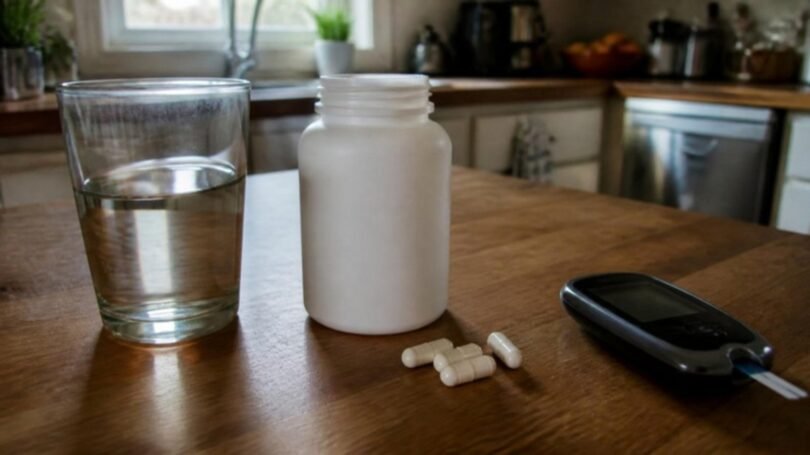
Summary: A vanadium supplement, usually sold as vanadyl sulfate, is marketed for blood sugar control and muscle building. A handful of tiny, short human studies from the 1990s and early 2000s found modest drops in blood sugar in people with type 2 diabetes, but reviews conclude there’s no rigorous evidence it works, and the one trial in weight-training athletes found no effect on muscle. Common doses also go well above the safe upper limit, so most people are better off skipping it.
If you’ve looked into a vanadium supplement, you’ve probably seen bold claims that it “mimics insulin” or helps bodybuilders get a better pump. Vanadium is a trace mineral (the chemical symbol is V) found in small amounts in food, soil and water. So what does the research actually show, and is it safe? Here’s an honest look at the evidence.
What is vanadium, and do we need it?
Unlike minerals such as zinc or magnesium, vanadium isn’t considered essential for people. The US Institute of Medicine (now the National Academies), which sets nutrient intake guidelines, concluded that “a biological role of vanadium in humans has not yet been identified” [1]. That’s why there’s no recommended daily amount for it.
Most adults take in about 6 to 18 micrograms (millionths of a gram) a day from food [1]. Foods relatively rich in vanadium include mushrooms, shellfish, black pepper, parsley and dill seed [1]. Very little of what you eat is absorbed: less than 5% makes it from your gut into your bloodstream, and the rest passes out in your stool [1].

Supplements are a different story. The most common form is vanadyl sulfate, an inorganic salt of vanadium. Supplement doses are measured in milligrams (thousandths of a gram), so a typical vanadium supplement delivers thousands of times more than you’d get from food.
Vanadium supplements and blood sugar
Strong results in animals
Interest in vanadium began in the 1980s, when researchers found that vanadium compounds lowered blood sugar in rats with diabetes, acting a bit like insulin (the hormone that moves sugar from your blood into your cells) [2]. Since then, chemists have designed dozens of “organic” vanadium compounds, where vanadium is bound to another molecule to make it easier to absorb. Most of this work has been done in animals and cells [3].
Small, short human studies
Human research is much thinner. In the 1990s and early 2000s, several small trials gave vanadyl sulfate to people with type 2 diabetes:
- 6 people, 3 weeks, 100 mg a day: fasting blood sugar and HbA1c (a measure of average blood sugar over recent months) dropped slightly, and the body responded better to insulin [4].
- 7 people with diabetes and 6 without, 3 weeks: insulin sensitivity improved in the people with diabetes, but nothing changed in the people without diabetes [5].
- 8 people, 4 weeks, 100 mg a day: fasting blood sugar fell by about 20%, and six of the eight had stomach side effects in the first week [6].
- 16 people, 6 weeks, 75 to 300 mg a day: blood sugar improved at the higher doses, but the authors concluded vanadyl sulfate “does not dramatically improve insulin sensitivity or glycemic control” at doses people could tolerate [7].
- 11 people, 6 weeks, 150 mg a day: fasting blood sugar and HbA1c dropped modestly, mainly because the liver released less sugar [8].
These results sound encouraging, but every one of these studies was tiny and short, and none met the standards of a high-quality controlled trial [9]. In a small randomized trial in 14 overweight people with prediabetes (impaired glucose tolerance), vanadyl sulfate didn’t improve insulin sensitivity at all, and it raised triglycerides (a type of blood fat) [10].
What the reviews conclude
A systematic review (a study that gathers and grades all the available research) searched 14 databases and found 151 studies, but not one met its basic quality standards: a controlled trial lasting at least 2 months with at least 10 people per group. The authors concluded there is “no rigorous evidence” that oral vanadium improves blood sugar control in type 2 diabetes and that routine use “cannot be recommended” [9].
A later review of 30 years of research reached a similar verdict. Human studies were all very short, long-term use raises the risk of vanadium building up in the body, and using vanadium to treat diabetes is “misplaced” [2]. One newer organic compound, BEOV, reached early clinical trials, with a phase IIa trial in just seven people with type 2 diabetes showing lower blood sugar after 28 days [11]. However, it hasn’t become an approved medicine, and it isn’t what’s sold in supplement bottles.
If you have diabetes, there are well-tested medicines that work. A vanadium supplement isn’t a substitute, and combining it with diabetes medication could, in theory, push your blood sugar too low. Talk to your doctor before trying it.
If you’re curious about other supplements sold for blood sugar, we’ve also looked at the evidence on corosolic acid from banaba leaf.
Does a vanadium supplement help build muscle?
Vanadyl sulfate became popular with bodybuilders on the idea that, if it acts like insulin, it might push more nutrients into muscle. Only one controlled trial has tested this properly. Researchers gave 31 weight-training volunteers either vanadyl sulfate (0.5 mg per kg of body weight a day) or a placebo (a dummy pill) for 12 weeks [12].
Both groups got stronger, as you’d expect from training, but vanadyl sulfate made no difference to body measurements or body composition. Two people in the vanadyl group dropped out because of apparent side effects. The authors concluded that vanadyl sulfate was “ineffective in changing body composition in weight-training athletes” [12]. The same trial found no changes in blood cells or in blood tests for liver and kidney function over the 12 weeks [13].
That’s a small study from the 1990s, and no newer trials have been done. On the evidence we have, vanadium doesn’t build muscle. The same is true of several other minerals marketed to lifters; see our look at whether ZMA supplements are worth the money.
Vanadium supplement safety and side effects
This is where vanadium deserves the most caution. The Institute of Medicine set a Tolerable Upper Intake Level (the highest daily amount unlikely to cause harm) of 1.8 mg of elemental vanadium a day for adults, based on kidney damage seen in animal studies [1]. The same report notes that weight-training athletes use up to 60 mg a day of vanadyl sulfate, which provides about 18.6 mg of vanadium, roughly 10 times the upper limit, and that doses used in diabetes research are much higher still [1].
Side effects reported in people include:
- Stomach and gut problems such as abdominal cramps and loose stools. These are the most common, and appeared in most participants in some diabetes trials [1, 6, 9].
- Other reported effects such as a green-tinged tongue, fatigue and lethargy, although these haven’t been seen consistently [1].
- Higher triglycerides in one small trial [10].
Short-term human studies at the doses tested haven’t shown serious harm [7, 13], but none lasted longer than about 3 months. Vanadium can build up in the body over time, especially in bone, and its long-term effects in people aren’t known [2, 11].
No safe upper limit could be set for children or for people who are pregnant or breastfeeding, so the report advises these groups to be particularly cautious; in practice, it’s best for them to avoid vanadium supplements [1]. People with kidney disease, and anyone taking diabetes medication, should also be particularly careful.
The bottom line
A vanadium supplement looks better on paper than in practice. Animal studies are impressive, but human evidence for blood sugar control comes from a handful of tiny, short studies, and the only trial in weight lifters found no benefit for muscle. Typical doses go well above the safe upper limit, and long-term safety is unknown.
You get all the vanadium you’re likely to need from a normal diet. If you want support with blood sugar or training, proven basics (diet, activity, sleep and, where needed, prescribed medicine) are a better place to put your money. And if you’re interested in a mineral that does matter for your health, read our article on zinc and testosterone.
This article is for general information only and isn’t medical advice. Talk to your doctor or another qualified health professional before starting a new supplement. See our medical disclaimer.
References
- Institute of Medicine (US) Panel on Micronutrients. Arsenic, boron, nickel, silicon, and vanadium. In: Dietary Reference Intakes for Vitamin A, Vitamin K, Arsenic, Boron, Chromium, Copper, Iodine, Iron, Manganese, Molybdenum, Nickel, Silicon, Vanadium, and Zinc. Washington, DC: National Academies Press; 2001. Chapter 13. nap.nationalacademies.org/read/10026/chapter/15
- Domingo JL, Gómez M. Vanadium compounds for the treatment of human diabetes mellitus: a scientific curiosity? A review of thirty years of research. Food Chem Toxicol. 2016;95:137-141. doi:10.1016/j.fct.2016.07.005
- Amaral LMPF, Moniz T, Silva AMN, Rangel M. Vanadium compounds with antidiabetic potential. Int J Mol Sci. 2023;24(21):15675. doi:10.3390/ijms242115675
- Cohen N, Halberstam M, Shlimovich P, et al. Oral vanadyl sulfate improves hepatic and peripheral insulin sensitivity in patients with non-insulin-dependent diabetes mellitus. J Clin Invest. 1995;95(6):2501-2509. doi:10.1172/JCI117951
- Halberstam M, Cohen N, Shlimovich P, et al. Oral vanadyl sulfate improves insulin sensitivity in NIDDM but not in obese nondiabetic subjects. Diabetes. 1996;45(5):659-666. doi:10.2337/diab.45.5.659
- Boden G, Chen X, Ruiz J, et al. Effects of vanadyl sulfate on carbohydrate and lipid metabolism in patients with non-insulin-dependent diabetes mellitus. Metabolism. 1996;45(9):1130-1135. doi:10.1016/s0026-0495(96)90013-x
- Goldfine AB, Patti ME, Zuberi L, et al. Metabolic effects of vanadyl sulfate in humans with non-insulin-dependent diabetes mellitus: in vivo and in vitro studies. Metabolism. 2000;49(3):400-410. doi:10.1016/s0026-0495(00)90418-9
- Cusi K, Cukier S, DeFronzo RA, et al. Vanadyl sulfate improves hepatic and muscle insulin sensitivity in type 2 diabetes. J Clin Endocrinol Metab. 2001;86(3):1410-1417. doi:10.1210/jcem.86.3.7337
- Smith DM, Pickering RM, Lewith GT. A systematic review of vanadium oral supplements for glycaemic control in type 2 diabetes mellitus. QJM. 2008;101(5):351-358. doi:10.1093/qjmed/hcn003
- Jacques-Camarena O, González-Ortiz M, Martínez-Abundis E, et al. Effect of vanadium on insulin sensitivity in patients with impaired glucose tolerance. Ann Nutr Metab. 2008;53(3-4):195-198. doi:10.1159/000175844
- Thompson KH, Lichter J, LeBel C, et al. Vanadium treatment of type 2 diabetes: a view to the future. J Inorg Biochem. 2009;103(4):554-558. doi:10.1016/j.jinorgbio.2008.12.003
- Fawcett JP, Farquhar SJ, Walker RJ, et al. The effect of oral vanadyl sulfate on body composition and performance in weight-training athletes. Int J Sport Nutr. 1996;6(4):382-390. doi:10.1123/ijsn.6.4.382
- Fawcett JP, Farquhar SJ, Thou T, Shand BI. Oral vanadyl sulphate does not affect blood cells, viscosity or biochemistry in humans. Pharmacol Toxicol. 1997;80(4):202-206. doi:10.1111/j.1600-0773.1997.tb00397.x