
Summary: Taking lysine and arginine together can briefly raise growth hormone when you’re resting, but the effect is small, inconsistent, and disappears once you exercise. There’s no good evidence the combo builds muscle or strength. Lysine on its own has mixed evidence for cold sores, and two short, company-linked trials suggest the pair might ease stress.
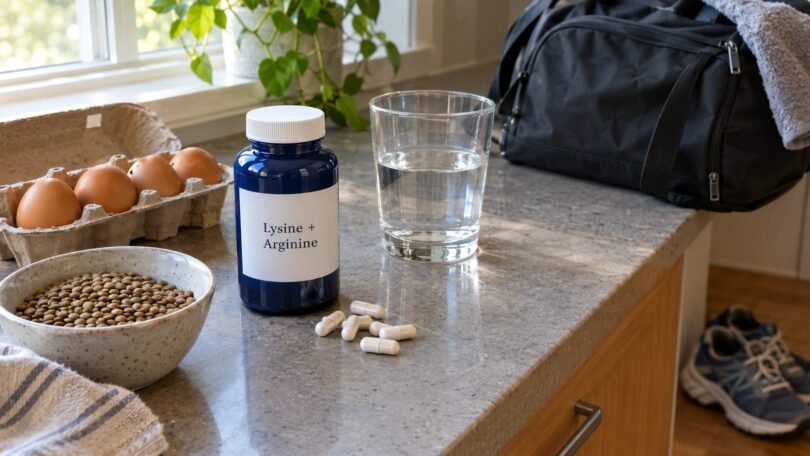
Lysine and arginine are two amino acids (the building blocks of protein) that are often sold together as a “growth hormone booster.” The idea comes from a handful of studies from the 1980s and 1990s. Here’s what those studies actually found, what newer research adds, and whether the combo is worth your money.
What are lysine and arginine?
Lysine is an essential amino acid, which means your body can’t make it and you have to get it from food. Arginine is “conditionally essential”: your body makes some, but you may need more from food during growth, illness or injury.
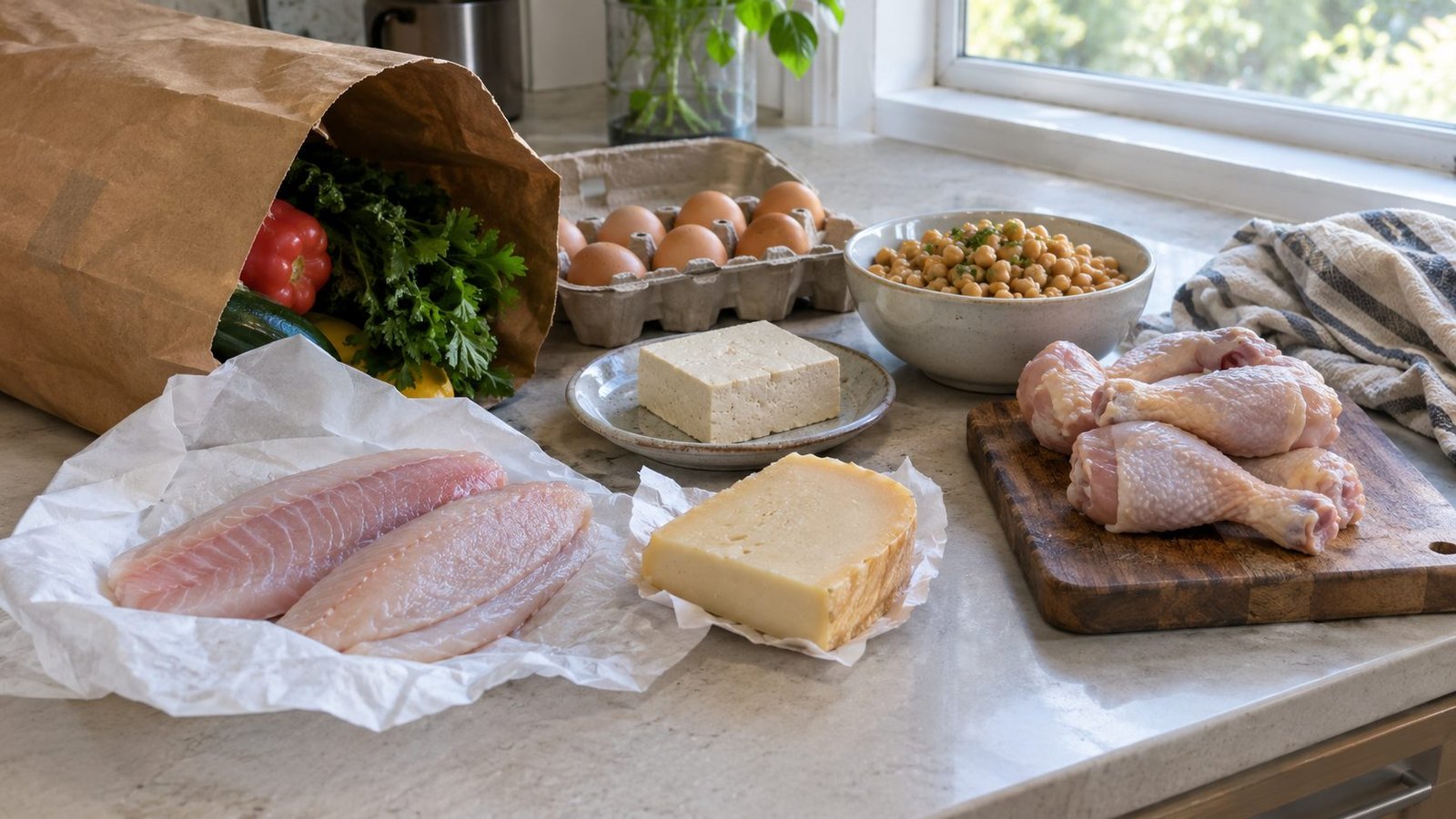
Both are found in protein-rich foods such as meat, poultry, fish, eggs, dairy, soybeans and other legumes. Current estimates put the adult lysine requirement at about 30 mg per kilogram of body weight per day, roughly 2 g a day for a 70 kg (154 lb) adult. Typical Western diets provide around 40–180 mg/kg a day, so most people already get more than enough without supplements [1]. (Older sources, including the earlier version of this article, quoted a much lower figure of 12 mg/kg; that number has since been revised upward.)
Do lysine and arginine raise growth hormone?
Growth hormone (GH) is a hormone released by the pituitary gland that helps regulate growth, metabolism and tissue repair. The claim that lysine and arginine boost it rests on a few small studies, and the results are mixed.
- The original study (1981): In 15 men, taking 1,200 mg of lysine plus 1,200 mg of arginine together raised GH, while neither amino acid did much on its own [2]. This is the study most supplement claims trace back to. It was small, and its methods are dated by today’s standards.
- At rest vs. during exercise (1997): In a randomized trial of 16 young men, 1,500 mg each of lysine and arginine raised GH about an hour later when they rested. But when they took the same dose right before a weight-training session, GH rose no more than with a placebo [3]. Exercise itself is a much stronger GH trigger.
- Commercial doses (1993): In seven male bodybuilders, a 2.4 g arginine/lysine supplement taken at the manufacturer’s recommended dose didn’t consistently change GH [4].
- Over a whole day (1993): In 11 competitive weightlifters, 2 g a day each of arginine, ornithine and lysine for four days didn’t change 24-hour GH levels compared with a placebo [5].
- In older men (1993): In 16 healthy men around age 69, 3 g of arginine plus 3 g of lysine twice a day for two weeks didn’t change GH or IGF-1 (a hormone that reflects GH activity over time) [6].
A review of amino acids marketed as GH releasers concluded that the GH response varies a lot from person to person, that oral doses big enough to cause a clear GH rise tend to cause stomach upset and diarrhea, and that no study found pre-workout amino acids boost exercise-induced GH. The authors didn’t recommend athletes use them for this purpose [7]. We cover arginine on its own in more detail in our article on L-arginine and growth hormone.
Would a growth hormone spike build muscle anyway?
Probably not. Even when lysine and arginine do nudge GH upward, the rise is short-lived. A 15-week training study found that big natural spikes in GH and other “anabolic” hormones after exercise didn’t lead to more muscle growth or strength than training without those spikes [8]. In other words, a brief GH bump isn’t the same as building muscle.
What about lysine’s direct effect on muscle? In rats, a single large dose of lysine slowed the breakdown of muscle protein for a few hours [9]. That’s interesting, but it hasn’t been shown in people, and the doses were far higher per kilogram than anyone would take.
One human trial in 50 women around age 77 found that a daily mix of HMB (a leucine breakdown product), arginine and lysine improved strength and a mobility test over 12 weeks [10]. Because the supplement had three ingredients, though, there’s no way to tell how much lysine and arginine contributed. If you’re interested in amino acids for training, see our reviews of arginine and ornithine and L-citrulline benefits.
Lysine and arginine for stress and anxiety
A more surprising line of research looks at lysine and arginine for stress. In a 10-day randomized trial of 29 healthy adults with fairly high anxiety, 3 g a day of each amino acid changed stress hormone responses to a public speaking task, which the authors read as a shift toward the pattern seen in calmer people [11]. A larger one-week trial of 108 healthy Japanese adults found that 2.64 g a day of each reduced self-reported anxiety and, in men, lowered morning cortisol (a stress hormone) [12].
These results are worth knowing about, but keep them in perspective: both trials were short, and both involved scientists from an amino acid manufacturer. Independent, longer studies are needed before lysine and arginine can be called a stress remedy.
Lysine for cold sores (and why arginine works against it)
Lysine’s best-known use has nothing to do with muscle. Cold sores are caused by the herpes simplex virus, which needs arginine to multiply. In lab studies, a high ratio of lysine to arginine slowed the virus down [13]. That’s the theory behind taking lysine to prevent outbreaks. It also means that pairing lysine with extra arginine works against the very reason people take lysine for cold sores.
The human trials are mixed and mostly old:
- An early uncontrolled study of 45 people reported faster healing and fewer recurrences with 312–1,200 mg of lysine a day [13].
- A placebo-controlled trial of 21 people found no benefit from 1,200 mg a day [14].
- A crossover trial of 41 people found that 1,248 mg a day may reduce how often outbreaks came back, but 624 mg a day didn’t, and neither dose sped up healing [15].
- A 12-month study of 26 people taking 1,000 mg a day found fewer outbreaks when blood lysine levels stayed high enough [16].
- A six-month trial of 52 people taking 3,000 mg a day reported fewer, milder and faster-healing outbreaks [17].
A 2017 review concluded that lysine looks ineffective below about 1 g a day, while doses above 3 g a day may help some people feel their outbreaks are less troublesome [18]. However, a 2015 Cochrane review (a rigorous summary of randomized trials) found no evidence that lysine prevents cold sores [19]. If you get frequent cold sores, talk to your doctor: prescription antiviral medicines have stronger evidence.
Other lysine claims
Lysine may help the body absorb and hold on to calcium. In a small study of women with and without osteoporosis (bone thinning), lysine increased calcium absorption from the gut and reduced the amount lost in urine [20]. This hasn’t been followed by trials showing better bone density or fewer fractures, so it’s an early finding rather than a reason to take lysine for your bones.
The earlier version of this article mentioned a single case report suggesting lysine might ease angina (chest pain from heart disease). One case report isn’t evidence, and we’ve removed that claim.
Lysine and arginine dosage, side effects and safety
Studies of the combination have used about 1.2–3 g of each amino acid a day, usually for days to a few weeks. There’s no official upper limit for either one.
- Lysine: A 2019 systematic review of 71 human studies found the main side effects were stomach-related (nausea, stomach ache and diarrhea). It suggested about 6 g a day as a provisional level with no observed side effects [21].
- Arginine: Doses large enough to affect GH commonly cause stomach discomfort and diarrhea [7]. In a trial of people who had just had a heart attack, 3 g of arginine three times a day didn’t help, and more people died in the arginine group (6 vs. 0), so the trial was stopped early. The authors advised against arginine after a heart attack [22].
- Cold sores: Because the herpes virus uses arginine, people prone to cold sores may want to avoid extra arginine [13].
- Who should check first: One review advises caution with lysine for people with heart or gallbladder disease [18]. Talk to your doctor before taking either supplement if you have a health condition, are pregnant or breastfeeding, or take regular medicines.
The bottom line on lysine and arginine
Lysine and arginine together can cause a small, short GH rise at rest in some people, but not during exercise, and that kind of spike doesn’t translate into extra muscle or strength. Most people already get plenty of both from protein-rich food. The stress findings are intriguing but early, and lysine’s evidence for cold sores is mixed. If you’re hoping to build muscle, consistent training and enough total protein will do far more than a lysine and arginine supplement.
This article is for general information only and isn’t medical advice. Talk to your doctor or another qualified health professional before starting a new supplement. See our medical disclaimer.
References
- Tomé D, Bos C. Lysine requirement through the human life cycle. J Nutr. 2007;137(6 Suppl 2):1642S–1645S. doi:10.1093/jn/137.6.1642S
- Isidori A, Lo Monaco A, Cappa M. A study of growth hormone release in man after oral administration of amino acids. Curr Med Res Opin. 1981;7(7):475–481. doi:10.1185/03007998109114287
- Suminski RR, Robertson RJ, Goss FL, et al. Acute effect of amino acid ingestion and resistance exercise on plasma growth hormone concentration in young men. Int J Sport Nutr. 1997;7(1):48–60. doi:10.1123/ijsn.7.1.48
- Lambert MI, Hefer JA, Millar RP, Macfarlane PW. Failure of commercial oral amino acid supplements to increase serum growth hormone concentrations in male body-builders. Int J Sport Nutr. 1993;3(3):298–305. doi:10.1123/ijsn.3.3.298
- Fogelholm GM, Näveri HK, Kiilavuori KT, Härkönen MH. Low-dose amino acid supplementation: no effects on serum human growth hormone and insulin in male weightlifters. Int J Sport Nutr. 1993;3(3):290–297. doi:10.1123/ijsn.3.3.290
- Corpas E, Blackman MR, Roberson R, Scholfield D, Harman SM. Oral arginine-lysine does not increase growth hormone or insulin-like growth factor-I in old men. J Gerontol. 1993;48(4):M128–M133. doi:10.1093/geronj/48.4.m128
- Chromiak JA, Antonio J. Use of amino acids as growth hormone-releasing agents by athletes. Nutrition. 2002;18(7–8):657–661. doi:10.1016/s0899-9007(02)00807-9
- West DWD, Burd NA, Tang JE, et al. Elevations in ostensibly anabolic hormones with resistance exercise enhance neither training-induced muscle hypertrophy nor strength of the elbow flexors. J Appl Physiol. 2010;108(1):60–67. doi:10.1152/japplphysiol.01147.2009
- Sato T, Ito Y, Nagasawa T. Regulation of skeletal muscle protein degradation and synthesis by oral administration of lysine in rats. J Nutr Sci Vitaminol (Tokyo). 2013;59(5):412–419. doi:10.3177/jnsv.59.412
- Flakoll P, Sharp R, Baier S, et al. Effect of beta-hydroxy-beta-methylbutyrate, arginine, and lysine supplementation on strength, functionality, body composition, and protein metabolism in elderly women. Nutrition. 2004;20(5):445–451. doi:10.1016/j.nut.2004.01.009
- Jezova D, Makatsori A, Smriga M, Morinaga Y, Duncko R. Subchronic treatment with amino acid mixture of L-lysine and L-arginine modifies neuroendocrine activation during psychosocial stress in subjects with high trait anxiety. Nutr Neurosci. 2005;8(3):155–160. doi:10.1080/10284150500162937
- Smriga M, Ando T, Akutsu M, et al. Oral treatment with L-lysine and L-arginine reduces anxiety and basal cortisol levels in healthy humans. Biomed Res. 2007;28(2):85–90. doi:10.2220/biomedres.28.85
- Griffith RS, Norins AL, Kagan C. A multicentered study of lysine therapy in Herpes simplex infection. Dermatologica. 1978;156(5):257–267. doi:10.1159/000250926
- DiGiovanna JJ, Blank H. Failure of lysine in frequently recurrent herpes simplex infection: treatment and prophylaxis. Arch Dermatol. 1984;120(1):48–51. PubMed 6419679
- McCune MA, Perry HO, Muller SA, O’Fallon WM. Treatment of recurrent herpes simplex infections with L-lysine monohydrochloride. Cutis. 1984;34(4):366–373. PubMed 6435961
- Thein DJ, Hurt WC. Lysine as a prophylactic agent in the treatment of recurrent herpes simplex labialis. Oral Surg Oral Med Oral Pathol. 1984;58(6):659–666. doi:10.1016/0030-4220(84)90030-6
- Griffith RS, Walsh DE, Myrmel KH, Thompson RW, Behforooz A. Success of L-lysine therapy in frequently recurrent herpes simplex infection: treatment and prophylaxis. Dermatologica. 1987;175(4):183–190. PubMed 3115841
- Mailoo VJ, Rampes S. Lysine for herpes simplex prophylaxis: a review of the evidence. Integr Med (Encinitas). 2017;16(3):42–46. PMC6419779
- Chi CC, Wang SH, Delamere FM, et al. Interventions for prevention of herpes simplex labialis (cold sores on the lips). Cochrane Database Syst Rev. 2015;(8):CD010095. doi:10.1002/14651858.CD010095.pub2
- Civitelli R, Villareal DT, Agnusdei D, et al. Dietary L-lysine and calcium metabolism in humans. Nutrition. 1992;8(6):400–405. PubMed 1486246
- Hayamizu K, Oshima I, Fukuda Z, et al. Safety assessment of L-lysine oral intake: a systematic review. Amino Acids. 2019;51(4):647–659. doi:10.1007/s00726-019-02697-3
- Schulman SP, Becker LC, Kass DA, et al. L-arginine therapy in acute myocardial infarction: the Vascular Interaction With Age in Myocardial Infarction (VINTAGE MI) randomized clinical trial. JAMA. 2006;295(1):58–64. doi:10.1001/jama.295.1.58